What Is the 1G Flat Plate Qualification?
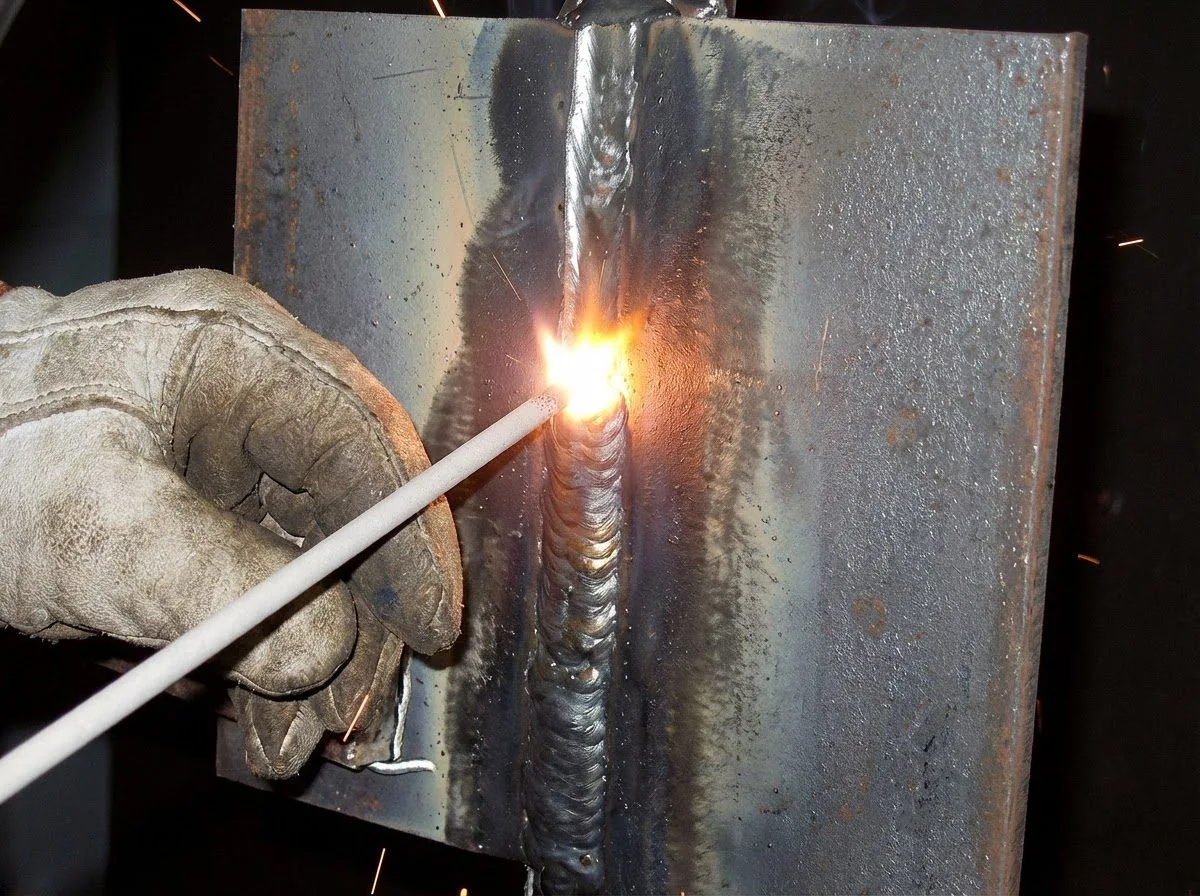
The AWS D1.1 1G plate qualification is a Complete Joint Penetration (CJP) groove weld test with the plate positioned horizontally and welded from above. The "1" designates flat position. The "G" designates groove weld.
In the flat position, gravity works in the welder's favor — it compresses the molten puddle into the joint rather than pulling it away. This makes the 1G the most accessible of the plate qualification positions and the starting point for most structural welder qualification programs. It is not a trivial test, but it is the position where basic weld technique is most clearly demonstrated without gravity as an adversary.
The AWS D1.1 1G flat plate qualification covers flat groove welds (1G) and flat and horizontal fillet welds (1F, 2F) per Table 6.10. Test on a 1-inch ASTM A36 plate for unlimited thickness qualification. One test plate, four bend specimens. Welded with the plate horizontal, plate welded from above. SMAW with E7018 is the most common process. The 1G is the lowest-cost D1.1 plate qualification and a common entry point for welder training programs and shop fabrication operations. It does not cover horizontal (2G), vertical (3G), or overhead (4G) groove positions — those require separate tests. WeldCertTest performs all CWI inspection in Alpharetta, GA (Timothy Dodd, AWS CWI #00120381). The result is an official WPQ record — not an AWS Certified Welder card, which is a separate program.
What the 1G Qualifies You For
The 1G flat groove test qualifies for groove welds in the flat position and fillet welds in both flat and horizontal positions per AWS D1.1 Table 6.10. The fillet weld coverage for 1F and 2F is a useful benefit — many shop fabrication operations involve horizontal fillet welds that the 1G covers without a separate fillet weld test.
| Weld Type | 1G Flat | 2G Horiz. | 3G Vert. | 4G OH | 1F | 2F | 3F | 4F |
|---|---|---|---|---|---|---|---|---|
| 1G Groove Test | ✓ | ✗ | ✗ | ✗ | ✓ | ✓ | ✗ | ✗ |
Should You Test 1G or Go Straight to 3G?
For most structural fabrication and field work, the 1G alone will leave gaps. The 3G vertical qualification covers everything the 1G covers — flat groove, flat and horizontal fillet — plus vertical groove positions, all for one test plate. Unless a project specifically requires flat-only qualification, or your shop exclusively positions all work flat before welding, the 3G is the smarter investment.
| Test | Flat | Horizontal | Vertical | Overhead | Plates |
|---|---|---|---|---|---|
| 1G Flat | ✓ | ✗ | ✗ | ✗ | 1 |
| 2G Horizontal | ✓ | ✓ | ✗ | ✗ | 1 |
| 3G Vertical | ✓ | ✓ | ✓ | ✗ | 1 |
| 3G/4G All-Position | ✓ | ✓ | ✓ | ✓ | 2 |
The 1G makes the most sense for welding programs with a controlled shop environment — rotators, positioners, or fixtures that keep all joints flat — and for welders who need to demonstrate basic groove weld proficiency before advancing to higher positions. It is also appropriate when a project quality plan specifically calls for flat-position qualification only.
Cost Considerations — The 1G Is the Lowest-Cost D1.1 Plate Test
The 1G is typically the lowest-cost welder qualification test for D1.1 structural work. One test plate, one position, four bend specimens. There is no two-plate test, no compound angles, no pipe coupon. For shops establishing baseline proficiency, training programs verifying entry-level skill, or contractors qualifying welders for flat-position-only work, the 1G is the most economical entry point into documented D1.1 welder qualification.
That said, the cost-effectiveness math is not always obvious. Consider:
- 1G alone — lowest absolute cost. Good for verified-flat-position work or training program entry.
- 1G now, 3G later — two separate tests with two separate fees, two separate bend test sets. Usually the most expensive path overall.
- 3G directly — modest premium over 1G. Covers everything the 1G covers PLUS vertical. Often the smartest single-plate investment.
- 3G/4G combined — two plates, covers all four positions. Higher upfront cost but the most coverage per dollar for welders who will see all positions.
Contact WeldCertTest at (404) 860-1288 or request a quote online for current pricing on any single test or combination. Volume pricing is available for shops testing multiple welders.
Test Plate Specifications
Thickness Qualification
| Test Plate | Min Production | Max Production | Recommendation |
|---|---|---|---|
| 3/8" (9.5mm) | 1/8" | 3/4" max | Light shop fab only |
| 1" (25mm) | 1/8" | Unlimited | Always use this |
Welding Processes for the 1G Test
The 1G flat position is compatible with all D1.1 qualified welding processes. Because gravity assists puddle control in the flat position, the 1G is where welders can demonstrate the cleanest, most controlled work regardless of process. One important note: the process used on the test plate is the only process qualified by that test — process changes in production require retesting.
| Process | Flat Position Behavior | Industry Acceptance | Notes |
|---|---|---|---|
| SMAW E7018 | Excellent | Universal | Best choice for structural D1.1 testing |
| FCAW-G | Excellent | Universal | High deposition, very clean flat welds |
| FCAW-S | Excellent | Check specs | Self-shielded, verify project acceptance |
| GMAW (MIG) | Excellent | Check specs | GMAW-S requires bends — no RT substitution |
| GTAW (TIG) | Excellent | Universal | Cleanest welds — slower deposition |
Flat Position Technique
The 1G flat position is where weld technique fundamentals are most clearly visible — there are no gravity-related distractions. The puddle is stable, the arc is controllable, and the results directly reflect the welder's consistency. Sloppiness that gravity would mask in other positions shows up plainly on a flat plate inspection.
Root Pass
- Aim directly at the root opening — not at the backing bar face
- Consistent travel speed is the single most important variable
- Maintain tight arc — long arcs increase spatter and reduce penetration
- Width of root bead should be uniform end to end
- Grind any high spots before fill passes — they create slag traps
- If using E7018, store in rod oven — moisture in coating causes porosity
Fill Passes
- Stringer beads or slight weave — both acceptable in flat position
- Build groove evenly — avoid filling one side ahead of the other
- Each pass should be slightly convex — flat or concave fill creates slag trap geometry
- Chip and wire brush every pass before the next — no exceptions
- Allow brief interpass cooling on thick plates to prevent heat buildup
- Maintain consistent amperage — don't creep it up as the groove fills
Cap Pass
- Reinforcement must stay at or below 3/16" above the base metal surface
- Tie cleanly into both plate edges — toe fusion is what the CWI looks at first
- Consistent travel speed end to end — stopping creates high spots
- Flat position allows slightly higher amperage on cap than vertical — use it for clean toes
- After welding, inspect both toes and the full weld surface before shipping
- Check for arc strikes on the plate surface adjacent to the weld zone
Electrode Angle — Flat
- Work angle: 90° perpendicular to the plate — straight down into the joint
- Travel angle: 5°–15° in the direction of travel (drag or push per process)
- SMAW: drag angle (lean slightly away from travel direction)
- FCAW/GMAW: check WPS — some specs require push angle
- Consistent angle throughout every pass — don't let technique drift
- Flat position amplifies any arc length inconsistency — keep it tight
Common 1G Test Failures
The 1G is the most forgiving plate position — but it still has failure modes. These are the most common reasons 1G plates fail visual inspection or bend testing.
Incomplete Root Fusion — Most Common Bend Test Failure
Root pass didn't fully tie into the backing bar or fully bridge the root opening. The bend specimen opens along the root on the bend test. Cause: insufficient amperage on root pass, arc aimed at backing bar instead of root opening, or travel speed too fast. Fix: Use slightly higher amperage on root than fill, aim arc directly at the root gap, verify 1/4" gap is consistent before starting.
Porosity from Moisture-Contaminated E7018
E7018 low-hydrogen electrodes absorb atmospheric moisture if not stored in a rod oven. Moisture in the coating releases hydrogen into the weld pool causing porosity — visible as small round holes in the weld surface or revealed on bend testing. Fix: Store E7018 in a rod oven at 250°F minimum. Electrodes left out more than a few hours should be reconditioned or discarded.
Arc Strikes Outside the Weld Zone
Automatic visual rejection per D1.1 Clause 4.9 regardless of position. Arc strikes on the plate surface adjacent to the weld zone create hardened spots that are potential crack initiation sites. Fix: Always strike the arc inside the joint. Inspect the full plate surface before shipping — an arc strike found by the CWI that the welder missed means an automatic rejection.
Excess Weld Reinforcement
Cap pass built too high — reinforcement exceeds 3/16" above the base metal surface. More common on flat plate than other positions because the gravity-assisted puddle builds easily. Fix: Monitor cap pass height continuously. If reinforcement is getting high, increase travel speed slightly. A flat profile is correct — a high crown is not.
Slag Inclusions Between Passes
Incomplete interpass cleaning — slag from a previous pass not fully removed before the next pass is deposited over it. Slag inclusions show up on bend specimens as linear discontinuities. Fix: Chip and wire brush every pass completely. Use a grinder on any slag trapped in corners or along the toes of the previous pass. Never weld over incomplete slag removal.
Visual Inspection Requirements
| Discontinuity | Limit | Notes |
|---|---|---|
| Cracks | None permitted | Any crack = immediate rejection |
| Incomplete fusion | None permitted | Anywhere in joint |
| Undercut | ≤ 1/32" (0.8mm) | Less common in flat but still checked |
| Reinforcement | ≤ 3/16" (4.8mm) | Most common flat position visual issue |
| Arc strikes | None outside weld zone | Automatic rejection |
| Overlap | None permitted | Weld metal over base metal surface |
| Porosity | Per D1.1 Clause 4.9.3 | Size and frequency limits apply |
Guided Bend Testing
Plates passing visual inspection proceed to accredited laboratory bend testing. The backing bar is removed before cutting. Four specimens are cut from the completed plate — two face bends and two root bends. Each is bent 180 degrees in a guided bend jig. All four must pass with no discontinuity exceeding 1/8" in any direction.
Mail-In Service — How It Works
-
Contact us for WPS and quote
Confirm process and plate thickness. We provide a D1.1 prequalified WPS and pricing. You may also use your company's existing qualified WPS covering the 1G flat position.
-
Weld the plate at your facility
Your welder completes the 1G plate under the WPS — plate horizontal, welding from above, 45° groove, 1/4" root opening, backing bar in place.
-
Ship the completed plate
Follow our shipping instructions. Standard ground shipping. Include welder name, contact info, and process with the shipment.
-
CWI visual inspection
Our AWS CWI performs full visual inspection per D1.1 Clause 4.9. We contact you on any visual rejection before proceeding to bend testing.
-
Accredited bend testing
Four specimens cut, prepared, and bent per D1.1 at our accredited lab. Full test documentation maintained.
-
WPQ issued and delivered
CWI signs and issues the official WPQ record on passing. Delivered by email and mail. See timeframes for current turnaround.
Industries and Applications for 1G Qualification
Structural Fabrication Shops
Shop fabrication environments with welding positioners, rotators, or fixtures that keep all joints flat are a natural fit for 1G-qualified welders. Beam fabrication, column assemblies, and shop-welded connections can all be positioned flat before welding.
Tank and Vessel Fabrication
Bottom plate welds on storage tanks and the flat seams on horizontal pressure vessels are direct 1G applications. Shops specializing in tank fabrication frequently qualify welders to the 1G position for bottom and floor weld work.
Training and Qualification Programs
Many welder qualification programs use the 1G as the entry-level test before advancing welders to higher position qualifications. It establishes baseline groove weld proficiency and is the foundation for the welder's qualification record.
Equipment and Machinery Manufacturers
Industrial equipment manufacturers, agricultural equipment fabricators, and heavy machinery builders with controlled shop environments often use welding positioners to maintain flat position on all critical groove welds — making the 1G a practical and sufficient qualification.
The 1G as Step One in a Welder Progression Plan
For trade schools, in-house apprenticeship programs, and structured welder development plans, the 1G is the natural first qualification in a staged progression. Each position builds on the prior — flat first, then horizontal, then vertical uphill, then overhead. A welder who progresses through this ladder ends up holding broad qualifications by stage rather than attempting the harder positions cold.
1G Groove Test
Baseline proficiency. Gravity assists. Focus: arc length, travel speed, electrode storage.
2G Groove Test
Adds gravity perpendicular to the joint. Focus: bead stacking, controlling sag.
3G Groove Test
Most welders' biggest skill jump. Vertical uphill weave technique becomes essential.
4G Groove Test
Final position. Gravity working entirely against the welder. Tight arc, low amperage.
Many training programs accelerate this by going straight to the 3G/4G combined test at the end of training — two plates, all four positions documented in a single WPQ. The 1G serves as the entry checkpoint, the 3G/4G serves as the credential. For programs running new welders through multiple positions over months of training, qualifying each step provides documented progress and lets the welder build experience under inspection at each level.
Using the 1G for Periodic Proficiency Verification
A use case worth noting for QC managers: the 1G can serve as a low-cost periodic proficiency check for welders who already hold broader qualifications. AWS D1.1 allows a CWI to require verification testing if there is specific reason to question a welder's ability (per the continuity clause — Clause 6.4.1 in D1.1:2020, renumbered Clause 6.4.1 in D1.1:2025). Some QC programs build periodic verification into their internal procedures even without a specific cause.
For QC managers building this kind of program: contact WeldCertTest to discuss scheduling multiple welders through periodic verification testing on a recurring schedule. This is more efficient than ad-hoc submissions and provides consistent documentation across your welder pool.
Glossary
Plate horizontal, welded from above. Gravity assists the puddle — most stable and controllable of all groove weld positions. Qualifies flat groove and flat/horizontal fillet per D1.1.
A groove weld with full fusion through the entire joint thickness. The 1G test uses a CJP single V-groove with permanent steel backing bar per D1.1 requirements.
A steel bar placed behind the root of the joint to support the root pass and ensure full penetration. The 1G test uses a 1/4" × 1" A36 permanent backing bar per D1.1.
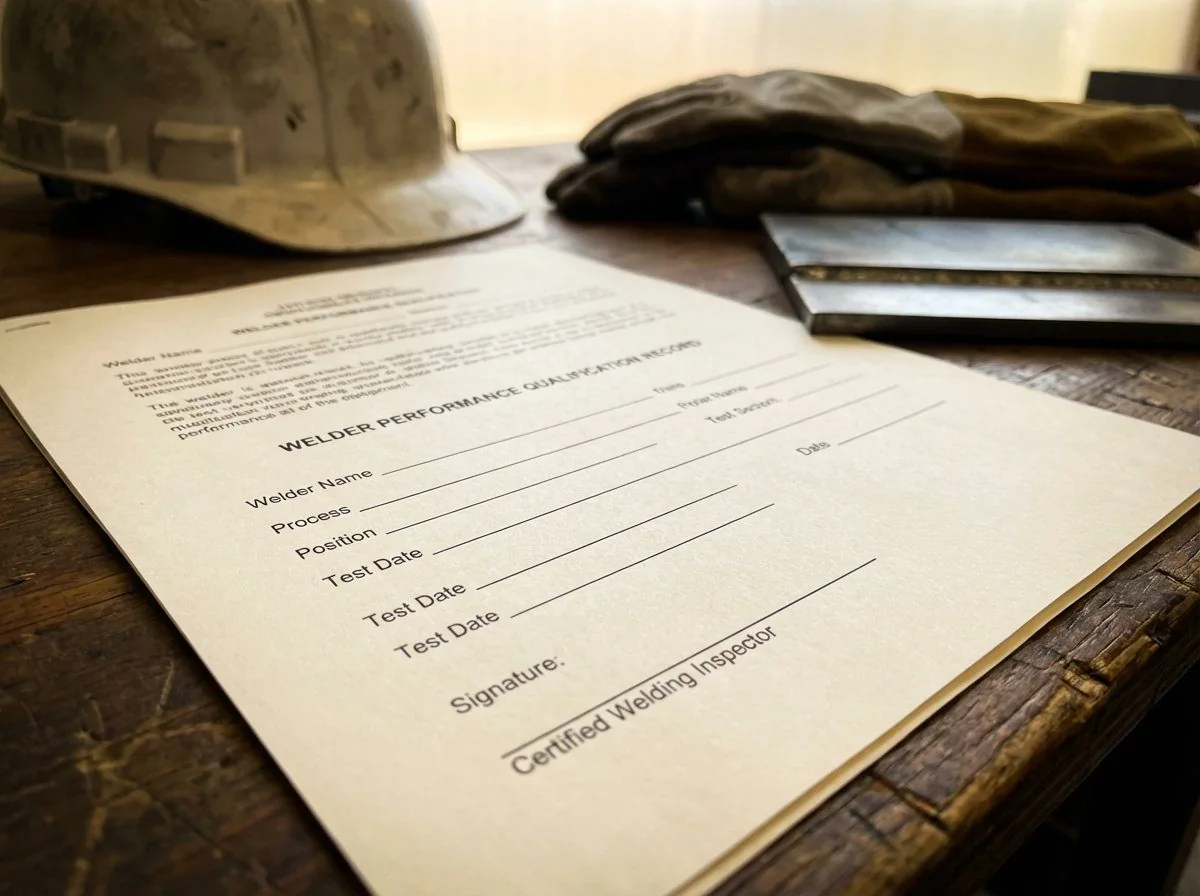
Welder Performance Qualification record — the official CWI-signed document certifying the welder passed the 1G test. Lists positions covered, process, thickness range, and test results.
Low-hydrogen iron powder SMAW electrode. The standard choice for structural groove weld testing. Requires storage in a rod oven to prevent moisture absorption. F-number 4, A-number 1 per D1.1.
Mechanical test where a weld specimen is bent 180 degrees in a controlled jig. Reveals incomplete fusion, porosity, and slag inclusions not visible on surface inspection. Pass/fail based on discontinuity size per D1.1 Clause 4.23.
Frequently Asked Questions
What positions does the 1G qualification cover?
Should I take the 1G or go straight to the 3G?
What is the easiest groove position to pass?
What plate thickness gives unlimited qualification?
Does the 1G cover horizontal fillet welds?
Can I mail in my 1G test plate?
Why do E7018 electrodes cause porosity if left out?
How long does the 1G certification stay valid?
Do I need a WPS for the 1G test?
What if the welder fails the 1G test?
Is the 1G the cheapest welder qualification test available?
Did AWS D1.1:2025 change anything about the 1G test?
Can the 1G be used to verify a welder's continuing proficiency without re-certifying?
Does the 1G test produce a WPQ record or an AWS Certified Welder card?
The People Behind the Inspection
Every coupon submitted to WeldCertTest is inspected by a named, currently-certified AWS CWI. When a project inspector asks who signed your WPQ, you have an answer.