API 1104 Pipeline Welder Qualification Testing
Mail-in API 1104 pipeline welder qualification for pipeline contractors, oil and gas operators, and cross-country transmission crews. Your welder runs the coupon at your facility under an approved WPS. Ship it to Alpharetta, GA. We handle CWI inspection, accredited bend and nick-break testing, and official WPQ documentation.
✓ We Test Your Coupons • ✗ We Are Not a Welding School • ✓ Official API 1104 WPQ Records Issued
Reviewed by: Timothy Dodd, AWS CWI #00120381 · ICC S2 Structural Welding Inspector
What Is API 1104 and Who Needs This Qualification?
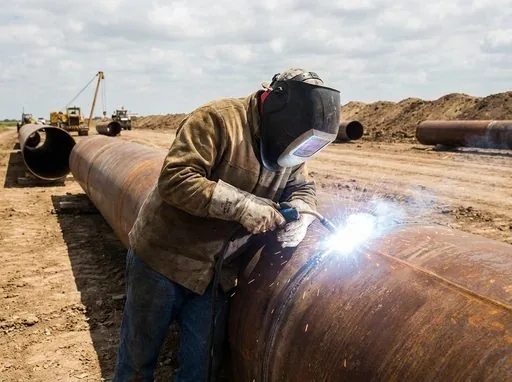
API Standard 1104, "Welding of Pipelines and Related Facilities," is the governing welding code for pipeline construction in the United States. Published by the American Petroleum Institute, it is referenced by 49 CFR Parts 192 (natural gas) and 195 (hazardous liquids) and enforced by the Pipeline and Hazardous Materials Safety Administration (PHMSA). Welder qualification under Section 6 is required for production welds on cross-country transmission pipelines, gathering systems, distribution mains, compressor stations, and pipeline maintenance. The qualification is based on a pipe coupon (plate is not accepted), with both visual examination and either guided bend or nick-break testing per Section 6.4. Uphill and downhill progression are separate essential variables under API 1104 — qualifying one does not cover the other. Current edition: 22nd Edition (July 2021) plus Errata 1 (2023); PHMSA-regulated work in the U.S. currently references the 21st Edition per a final rule effective June 28, 2024. WeldCertTest issues WPQ records under either edition based on your operator's specifications. CWI inspection in Alpharetta, GA (Timothy Dodd, AWS CWI #00120381). An API 1104 WPQ is the official document — not an AWS Certified Welder card, which is a separate AWS structural program.
API Standard 1104, published by the American Petroleum Institute, is the governing welding standard for pipeline construction in the United States and internationally. It covers welding of cross-country transmission pipelines, gathering systems, distribution mains, compressor stations, pump stations, and associated facilities. If steel pipe carries natural gas, crude oil, refined petroleum products, or water under pressure in a pipeline environment, API 1104 is almost certainly the applicable standard.
Any welder who performs production welds on pipeline construction covered by API 1104 must hold a current qualification under that standard. This applies to:
- Cross-country natural gas and liquid petroleum transmission line welders
- Gathering system and midstream pipeline construction crews
- Distribution main and service line welders working under utility operators
- Compressor station and pump station piping welders
- Maintenance and repair welders working on existing pipeline infrastructure
- Tank farm and terminal piping welders where the operator specifies API 1104
API 1104 vs. AWS D1.1: Know the Difference
These are two different codes for two different industries. Using the wrong qualification is a compliance failure, not a technicality. Here is how they compare:
| Factor | API 1104 | AWS D1.1 |
|---|---|---|
| Primary Application | Pipeline construction & maintenance | Structural steel fabrication |
| Governing Body | American Petroleum Institute | American Welding Society |
| Test Coupon Type | Pipe only | Plate or pipe |
| Plate Test Covers Pipe? | No | Partially |
| Progression (Up/Down) | Both — must qualify each | Position-based coverage |
| Downhill Progression Covered? | Only if specifically qualified | N/A — not a separate variable |
| Nick-Break Test | Yes — common for thin wall | Not standard |
| Regulatory Backing | 49 CFR 192/195 (PHMSA) | Building/bridge codes |
| Cross-Qualification | Does not satisfy D1.1 | Does not satisfy API 1104 |
API 1104 Section 6 — Qualification Structure
Section 6 of API 1104 covers welder qualification entirely. Understanding its structure is critical to knowing what you need to test and what your qualification covers.
6.1 — General
Establishes that each company must maintain a current record of each qualified welder and the procedures they are qualified to use. Qualification is employer-specific — a welder qualified under Company A's procedures must requalify when moving to Company B unless specific arrangement is made.
6.2 — Qualification Variables
Defines essential variables that trigger requalification when changed: welding process, pipe diameter group, wall thickness group, filler metal class, joint design, position, and welding progression direction. Downhill and uphill are treated as separate essential variables — qualifying one does not cover the other.
6.3 — Qualification Tests
Specifies the test coupon configuration, number of specimens required, and test methods. The test must be performed in accordance with an approved welding procedure specification. WeldCertTest evaluates all coupons per this section using visual examination, guided bend testing, and nick-break testing as applicable.
6.4 — Acceptance Criteria
Sets visual and mechanical acceptance criteria. Visual inspection checks for cracks, incomplete fusion, surface porosity, undercut, and weld profile compliance. Bend specimens must show no cracks or other defects exceeding 3 mm (1/8 inch). Nick-break surfaces must show complete fusion, no cracks, and porosity within specified limits.
6.5 — Records & Continuity
Requires the company to maintain qualification records for each welder. Qualification expires if the welder has not used the qualified process for six consecutive months. The record must show continuous use. When qualification expires, a new test coupon is required — there is no grace period or shortened path back.
6.6 — Automatic Welding
Addresses qualification of automatic and semiautomatic welding operators — a separate qualification path from manual welder qualification. If your project involves mechanized or automated welding systems, different qualification requirements apply. Contact us to discuss your specific application.
API 1104 Position Coverage — What Your Test Qualifies
Position coverage under API 1104 is determined by the orientation of the pipe axis during the qualification test. Testing on the most challenging position gives the broadest coverage for field work.
| Test Position | Pipe Axis | D1.1 Equivalent | Positions Covered | Best For |
|---|---|---|---|---|
| Axis Horizontal, Fixed | Horizontal — pipe cannot rotate | 5G / 6G (without incline) | All positions | Cross-country pipeline, all field work |
| Axis Inclined, Fixed (45°) | 45° incline — comparable to 6G | 6G | All positions | Broadest single qualification available |
| Axis Vertical | Vertical — pipe end up | 2G | Horizontal only | Limited — horizontal position production welds |
| Axis Horizontal, Rotating | Horizontal — pipe rotates (flat position) | 1G | Flat (1G) only | Shop rotator work only — not for field |
Pipe Diameter Coverage Groups
API 1104 groups pipe by outside diameter. Your test coupon OD determines the range of pipe you are qualified to weld in production.
| Test Coupon OD | Production OD Qualified | Notes |
|---|---|---|
| Under 2⅜ inch | Up to test OD only | Very limited — small distribution pipe |
| 2⅜ inch to 4½ inch | Up to 4½ inch OD | Small gathering and distribution lines |
| Over 4½ inch to 12¾ inch | Over 4½ inch up to 12¾ inch | Medium diameter transmission and distribution |
| Over 12¾ inch | Unlimited OD | Full coverage — recommended for transmission line welders |
Downhill vs. Uphill Progression — The Pipeline Industry's Defining Choice
Of all the essential variables under API 1104, progression direction (uphill versus downhill) is the one that catches contractors and welders by surprise more than any other. The two techniques produce different welds, use different electrodes, and operate at different speeds — and they are separately qualified. Understanding this before you order a test prevents a common and expensive mistake.
Downhill With Cellulosic Electrodes — The Cross-Country Standard
The reason downhill progression with E6010 and E7010-G cellulosic electrodes dominates U.S. pipeline construction is not preference — it is productivity. A cross-country transmission pipeline construction crew may make a girth weld every 1.5 to 2.5 minutes on smaller diameter line pipe. Downhill cellulosic welding is the only SMAW technique fast enough to keep pace with a moving pipeline spread.
The electrode and technique fit each other: cellulosic coating produces a forceful, deep-penetrating arc with fast-freezing slag, which lets the welder travel downhill quickly while the puddle solidifies before it can sag. Low-hydrogen electrodes (E7018, E8018) are physically capable of being run downhill, but their slower-freezing slag makes downhill technique difficult and slag entrapment far more likely. The pipeline industry standardized on cellulosic for cross-country work because it works at production speed.
For API 1104 qualification, this means: if your production work uses downhill cellulosic technique (and most cross-country transmission and gathering work does), you must qualify downhill with the same electrode family you will use in production. An uphill qualification with E7018 does not cover downhill production work with E6010.
When Each Progression Applies
| Application | Typical Progression | Typical Electrodes | Reason |
|---|---|---|---|
| Cross-country natural gas transmission | Downhill | E6010 root + E7010-G fill/cap | Production speed required for pipeline spread |
| Cross-country liquid petroleum transmission | Downhill | E6010 root + E7010-G fill/cap | Production speed and cellulosic penetration |
| Gas gathering system construction | Downhill | E6010 root + E7010-G fill/cap | Industry standard for gathering work |
| Distribution main installation | Downhill (typical) | E6010 / mechanized GMAW | Field productivity |
| Compressor station shop fabrication | Uphill (common) | E7018 / E8018 / GTAW + FCAW | Heavier wall, controlled shop environment |
| Higher-strength line pipe (X70, X80 grade) | Uphill (often required by spec) | Low-hydrogen E8018 / E9018 / FCAW | Hydrogen cracking control on HSLA steels |
| In-service repair welding (Annex B) | Uphill (typical) | Low-hydrogen E7018 / E8018 | Hydrogen control on operating pressurized pipe |
| Tie-in welds at pipeline crossings | Either — per operator spec | Varies | Critical-location welds often specify uphill |
Which API 1104 Edition Applies to Your Project?
API 1104 is revised approximately every 5 to 7 years. The current published edition is the 22nd Edition (July 2021, with Errata 1 issued in 2023). However, for U.S. pipeline construction subject to PHMSA jurisdiction, the regulatory references currently point to the 21st Edition — this creates a real-world situation where the published code and the federally-regulated code are different editions.
Edition Comparison
| Aspect | 21st Edition (2013) | 22nd Edition (2021) |
|---|---|---|
| Publication Year | September 2013 + Errata through 2018 + Addenda 2014/2016 | July 2021 + Errata 1 (2023) |
| PHMSA Regulatory Reference | Current (per 2024 final rule) | Not yet incorporated by reference |
| Essential Variable Framework | Traditional structure | New Category I & II framework for standard WPSs |
| In-Service Welding (Annex B) | Established requirements | Updated guidance and references |
| Typical Use Today | U.S. federally-regulated pipeline work | International work, operator-specified, non-PHMSA |
Common Processes and Electrodes — API 1104 Pipeline Welding
The welding process and filler metal are essential variables under API 1104. Qualifying with one process does not cover another. Here are the most common combinations used in pipeline qualification testing.
SMAW — Stick (Downhill)
The dominant process for cross-country pipeline construction. Cellulosic electrodes — E6010 for stringer and hot passes, E7010 for fill and cap — are the backbone of transmission line welding. Fast deposition, excellent penetration, field-rugged. Downhill progression is standard. Must be specifically qualified downhill.
Common electrodes: E6010, E7010-P1, E8010-P1
SMAW — Stick (Uphill)
Low-hydrogen electrodes uphill are used in higher-strength pipe applications, sour gas service (H₂S environments), and some repair scenarios where toughness requirements exceed what cellulosic electrodes deliver. E7018 and E8018 are common. Must be qualified uphill — does not carry over from downhill qualification.
Common electrodes: E7018, E8018-C3, E9018-G
GMAW / FCAW
Self-shielded FCAW and solid wire GMAW are used in certain pipeline applications, particularly shop fabrication of fittings and offshore pipeline work. Dual-shield FCAW (gas-shielded flux core) offers high deposition rates for large diameter wall. Each process must be separately qualified under API 1104.
Common wires: E71T-8 (self-shielded), ER70S-6 (GMAW), E71T-1 (FCAW-G)
GTAW — TIG Root Pass
TIG root passes are common in process piping tied to pipeline systems — compressor stations, meter sets, and high-pressure fittings where a perfect root is required. Often combined with SMAW fill and cap (GTAW+SMAW combination procedure). Each process in the combination must be qualified.
Common filler: ER70S-2, ER70S-6
How WeldCertTest Tests Your API 1104 Pipeline Coupon
Every API 1104 test coupon we receive goes through a documented examination sequence performed by our Certified Welding Inspector. Here is exactly what happens when your coupon arrives.
- Receiving and Documentation — Your coupon is logged in, welder identification is confirmed, and the pipe OD, wall thickness, and reported welding process are recorded. The coupon is marked for traceability through the examination process.
- Visual Examination (Section 9.3 / Section 6.4) — The CWI performs visual inspection of the weld crown, root face (if accessible), and weld profile. We check for cracks, incomplete fusion, incomplete penetration, surface porosity, undercut exceeding API 1104 limits, and any burn-through. Visual results are documented before any mechanical specimens are cut.
- Specimen Cutting — Test specimens are cut from the required locations around the pipe circumference. Specimen quantity and location follow API 1104 Section 6.3 requirements based on pipe OD. Larger diameter pipe requires more specimens to represent the full circumferential weld.
- Guided Bend Testing — Root and face bend specimens are bent in our guided bend fixture to the required mandrel diameter. The bent specimens are examined for cracks, incomplete fusion, and other defects. Acceptance criteria per Section 6.4 — no cracks or defects exceeding 3 mm (⅛ inch) in any direction.
- Nick-Break Testing — For applicable pipe sizes and joint configurations, nick-break specimens are notched and fractured. The fracture surface is examined for porosity, slag inclusions, incomplete fusion, and cracks. API 1104 specifies maximum allowable porosity by size and distribution on the fracture face.
- WPQ Documentation — Upon passing, we issue the Welder Performance Qualification record documenting all essential variables, test results, and examiner certification. This is your official qualification document.
Preparing Your API 1104 Test Coupon
Your test coupon must be welded in accordance with your company's approved API 1104 welding procedure specification (WPS). Before shipping:
- Confirm your WPS is approved and covers the pipe OD, wall, material, process, and position you are testing
- Use the correct electrode or filler wire classification listed on the WPS
- Weld in the correct progression direction (uphill or downhill as specified)
- Do not grind the weld crown flush — we need to see the as-welded surface for visual inspection
- Mark the coupon with welder ID, date welded, position, and process before shipping
- Package per our shipping instructions — pipe coupons need proper crating to arrive undamaged
Where API 1104 Qualification Is Required
API 1104 qualification is required wherever the operator or applicable regulations designate it as the governing welding standard. This covers a wide range of pipeline infrastructure types.
| Application | Regulatory Requirement | Typical Pipe Size | Notes |
|---|---|---|---|
| Interstate Natural Gas Transmission | 49 CFR Part 192 (PHMSA) | 12¾" to 48"+ OD | Federal DOT jurisdiction — strict documentation requirements |
| Intrastate Gas Distribution | State pipeline safety regulations | 2" to 24" OD | State-regulated — most states adopt API 1104 |
| Hazardous Liquid Pipelines | 49 CFR Part 195 (PHMSA) | 4" to 48"+ OD | Crude oil, refined products, CO₂, anhydrous ammonia |
| Crude Oil Gathering Systems | Operator spec / 49 CFR Part 195 | 2" to 20" OD | Midstream operators typically require API 1104 |
| Natural Gas Gathering | 49 CFR Part 192 (regulated); operator spec (unregulated) | 2" to 20" OD | Regulation depends on location class and pressure |
| Compressor Station Piping | 49 CFR Part 192 / operator spec | Varies | Often includes both API 1104 and ASME B31.8 requirements |
| Offshore Pipeline | API 1104 + BSEE regulations | 4" to 36"+ OD | Bureau of Safety and Environmental Enforcement oversight |
| Pipeline Repair Welding | ASME B31.4 / B31.8 / 49 CFR | Existing pipe OD | In-service repair qualifications have additional requirements |
Real-World API 1104 Production Welding Scenarios
The applications table above shows the regulatory categories. Below is what those projects actually look like on the ground — the specific production welding scenarios where an API 1104 qualification is the working credential.
Cross-Country Pipeline Spread
A pipeline construction spread moves down the right-of-way at 1–2 miles per day, laying line pipe and welding girth welds at the joint. Field welders qualified downhill with E6010/E7010-G run the roll passes (root, hot pass, fill, cap) on each girth weld. Production speed and consistency are everything. This is the highest-volume API 1104 production scenario.
Tie-In and Crossing Welds
Where the pipeline spread connects to existing pipeline, crosses a road, river, or another pipeline, or terminates at a station, welders perform tie-in welds outside the production spread. These are often more critical-position welds with stricter NDE requirements. Welder qualifications must cover the position (often fixed horizontal or inclined) and progression specified for the tie-in.
Gathering System Pad Construction
Upstream natural gas and crude oil gathering at well pads, compressor stations, and central tank batteries. Smaller diameter pipe (typically 2–12 inch), often multiple operators on a single pad. Welders need API 1104 qualification covering the diameter group and process the operator specifies. Both downhill and mechanized GMAW are common.
Gas Distribution Main & Service Lines
Local gas utility distribution mains (typically 2–24 inch) and individual service lines to homes and businesses. Steel and PE pipe work; steel welding requires API 1104 under most state pipeline safety programs. Many utilities maintain their own in-house qualification programs based on API 1104 plus operator-specific procedures.
Compressor and Pump Station Piping
Above-grade station piping at compressor stations (gas) and pump stations (liquid). Heavier wall, more complex fittings, often higher pressure than the line pipe itself. Some operators specify API 1104 with additional requirements; others specify ASME B31.8 or B31.4 for station piping. Verify the controlling code before testing.
Pipeline Maintenance & In-Service Repair
Repair welding on existing operating pipelines — sleeve installations, weld-on fittings, hot tap connections, and direct-deposit repair welds. Governed by API 1104 Section 9 and Annex B (in-service welding). Requires additional qualification beyond basic API 1104 — typically a separate in-service welding qualification on a coupon that simulates the heat sink and constraint of an operating pipeline.
API 1104 Essential Variables — When You Must Requalify
An essential variable is any change that, when made, invalidates your existing qualification. Any of the following changes requires a new test coupon and new qualification under API 1104 Section 6.2.
Changing from SMAW to FCAW, GMAW to GTAW, or any other process change requires requalification. Combined process qualifications must be tested as a combination.
Moving to a smaller OD group than your qualification covers requires a new test. Testing on the largest group (over 12¾ inch) gives unlimited coverage going forward.
Production wall thickness exceeding the range covered by your test coupon requires requalification. Test on heavier wall to cover the broadest range.
Changing electrode or filler metal classification requires requalification. Switching from E6010 to E7010, or from SMAW to FCAW wire, are separate essential variables.
Downhill and uphill are separate essential variables. A downhill qualification does not cover uphill welding and vice versa. This is one of the most commonly overlooked qualification gaps.
A rotating (1G) or vertical (2G) axis qualification does not cover the horizontal fixed position (5G/6G equivalent). Test on horizontal fixed to cover all field positions.
A significant change in joint design — such as adding or removing backing — may constitute an essential variable change depending on the specific modification.
API 1104 groups base metals. Moving to a different group or a higher strength grade than covered by your qualification may require requalification depending on the specific change.
API 1104 Welder Qualification — Frequently Asked Questions
Does API 1104 allow mail-in welder qualification testing?
What positions does API 1104 welder qualification cover?
How is API 1104 different from AWS D1.1 for welder qualification?
What are essential variables under API 1104 that require requalification?
What is the difference between uphill and downhill progression in API 1104?
What pipe diameter and wall thickness ranges are covered by an API 1104 qualification?
How long is an API 1104 welder qualification valid?
What testing is required to pass an API 1104 welder qualification?
Can I qualify for API 1104 using a butt weld on plate instead of pipe?
What documentation is issued after passing an API 1104 welder qualification?
What edition of API 1104 is currently in use?
What types of pipeline production welds actually require API 1104 qualification?
Does an API 1104 qualification produce a WPQ record or an AWS Certified Welder card?
Why are cellulosic electrodes like E6010 and E7010 standard for pipeline welding?
API 1104 Pipeline Welding — Key Terms
Understanding the terminology in API 1104 prevents qualification gaps and field rejections.
- API 1104
- American Petroleum Institute Standard 1104, Welding of Pipelines and Related Facilities. The primary welding standard for pipeline construction in the United States, referenced by 49 CFR Parts 192 and 195.
- Essential Variable
- A characteristic of the welding procedure or qualification that, when changed, invalidates the existing qualification and requires a new test coupon and new WPQ. Defined in API 1104 Section 6.2.
- WPQ (Welder Performance Qualification)
- The official record documenting that a welder has successfully completed a qualification test under a specific welding procedure. Required to be maintained by the employer and presented to pipeline operators and inspectors.
- WPS (Welding Procedure Specification)
- The written document that specifies the welding variables for a given application. Welders must test using an approved WPS. The WPS must be separately qualified under API 1104 Section 5 before it can be used for welder qualification testing.
- Cellulosic Electrode
- A high-cellulose SMAW electrode (E6010, E7010) characterized by deep penetration, fast freezing slag, and suitability for downhill progression. The dominant electrode type in cross-country pipeline construction. Produces a more fluid puddle than low-hydrogen electrodes.
- Nick-Break Test
- A destructive test method used in API 1104 qualification where a weld specimen is notched at the weld centerline and fractured. The fracture surface is examined for porosity, incomplete fusion, slag inclusions, and cracks. Common for thin wall pipe qualification.
- Downhill Progression
- Welding from the top of the pipe downward on each side — the welder travels in the direction of gravity. Standard for cross-country pipeline SMAW with cellulosic electrodes. Must be specifically qualified — not covered by uphill qualification.
- 49 CFR Part 192
- Federal safety standards for transportation of natural gas and other gas by pipeline, issued by PHMSA. References API 1104 as the applicable welding standard for most pipeline welding operations under its jurisdiction.
- PHMSA
- Pipeline and Hazardous Materials Safety Administration — the U.S. DOT agency that regulates pipeline safety under 49 CFR Parts 192 and 195. PHMSA jurisdiction covers interstate natural gas and hazardous liquid pipeline systems.
The People Behind the Inspection
Every API 1104 coupon submitted to WeldCertTest is inspected by a named, currently-certified AWS CWI. When a pipeline operator or jurisdictional inspector asks who signed your WPQ, you have an answer.


Ready to Qualify Your Pipeline Welders?
Mail your test coupon. We handle CWI inspection, accredited bend and nick-break testing, and issue the official WPQ. Pipeline contractors nationwide trust WeldCertTest.
Content reviewed by Timothy Dodd, AWS CWI #00120381 · Last reviewed May 16, 2026