Short version: they're two separate documents from two separate programs.
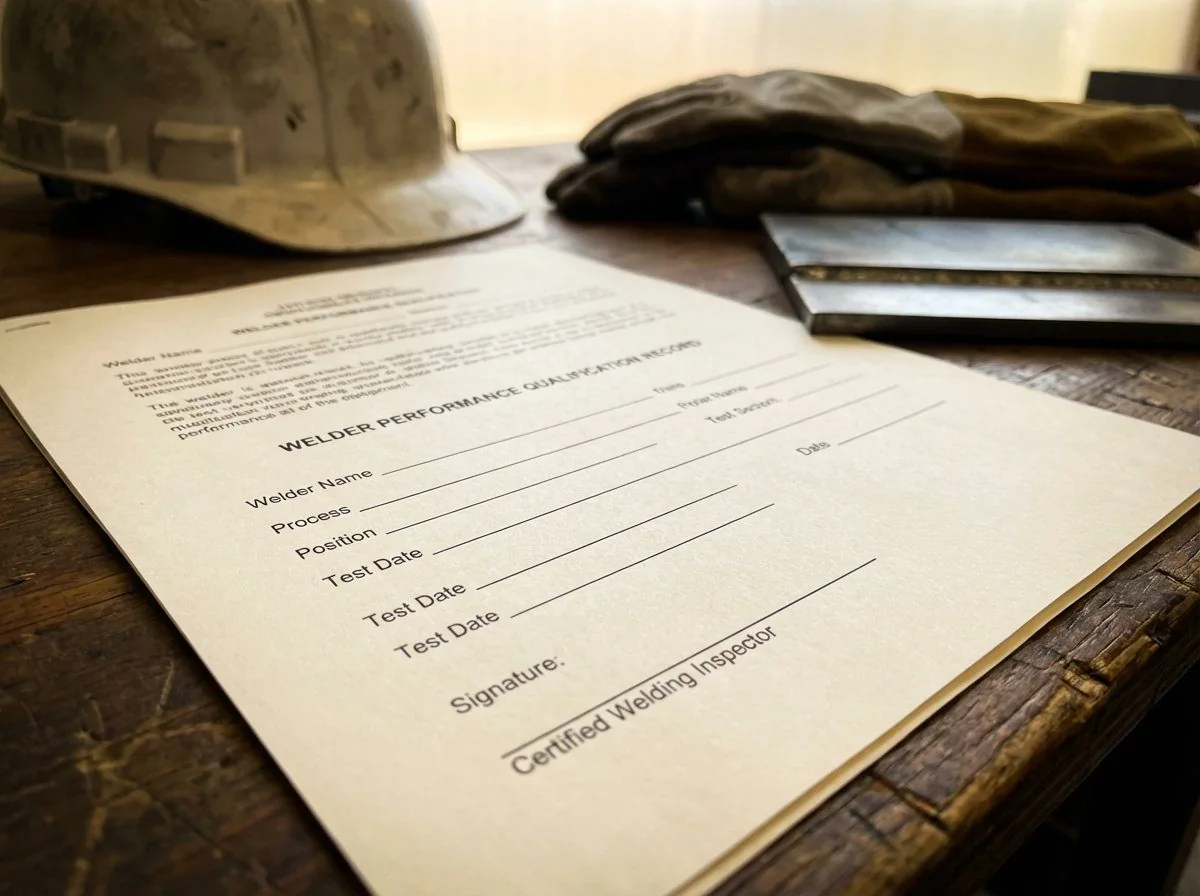
A WPQ (Welder Performance Qualification record) is a code-required document under AWS D1.1 and similar welding codes, signed by a Certified Welding Inspector, that proves a specific welder passed a specific test under specific conditions. An AWS Certified Welder card is an individual portable credential issued only by the American Welding Society through Accredited Test Facilities under the QC7 program. Most structural steel projects require a WPQ. Most do not require the AWS card. A welder can hold both, one, or neither depending on what their projects demand.
Side-by-Side Comparison
The fastest way to see the difference is to put the two documents next to each other. Every row below comes from the actual governing standards — AWS D1.1 for the WPQ side, AWS QC7 for the Certified Welder side.
| WPQ Record | AWS Certified Welder Card | |
|---|---|---|
| What it is | A code-required document proving a welder passed a performance qualification test | An individual portable credential issued by AWS, listed in the National Registry of Certified Welders |
| Governing standard | AWS D1.1 (or ASME IX, API 1104, AWWA, etc. depending on application) | AWS QC7 — Standard for AWS Certified Welders |
| Issued by | Testing facility / employer with CWI on staff or contract | American Welding Society directly, through an Accredited Test Facility (ATF) |
| Required by D1.1? | Yes — D1.1 Clause 6.19 mandates documented welder performance qualification | No — D1.1 does not require AWS Certified Welder cards |
| Tied to employer? | Yes — qualifications are typically associated with the employer's quality program and WPS | No — the card belongs to the welder and transfers between employers |
| Maintenance | Per D1.1 Clause 6.4.1: welder uses process at least every 6 months, employer documents it | Welder submits maintenance form to AWS every 6 months (or per the governing code) |
| Cost structure | Per-test pricing from the testing facility (no AWS registration fees) | Test cost at ATF + AWS registration fees + ongoing maintenance fees |
| Most projects accept | Universally accepted on D1.1, ASME, API, AWWA projects when properly executed | Accepted by some employers, especially as a hiring credential — but does not replace project-required WPQ documentation |
What a WPQ Record Actually Is
A Welder Performance Qualification record — abbreviated WPQ (sometimes written WPQR, for Welder Performance Qualification Record) — is the document that proves a welder demonstrated the ability to produce sound welds meeting code requirements under specific conditions.
Per AWS D1.1 Clause 6.19, a welder must follow a qualified Welding Procedure Specification (WPS) and produce welds that pass code acceptance criteria. The results — visual inspection, bend testing or radiographic testing, essential variables documented — are recorded on a WPQ form. That form, signed by an AWS Certified Welding Inspector, is the WPQ.
What appears on a WPQ
- Welder name and employer
- Welding process (SMAW, GMAW, FCAW, GTAW, etc.) and filler metal classification
- Test position and all positions qualified by that test (not just the test position)
- Base metal specification and qualified production thickness range
- Visual inspection results per the applicable code clause
- Bend test results — face bends, root bends, side bends — or RT results where permitted
- WPS reference number used during qualification
- CWI name, certification number, and signature
- Date of qualification (which starts the continuity clock)
What makes a WPQ valid
A WPQ is valid when (1) it was issued under a qualified WPS, (2) the essential variables are documented, (3) the test coupon passed acceptance criteria per the applicable code, (4) a CWI signed it, and (5) the welder maintains continuity per the applicable code's requirements. Miss any of those five, and the WPQ is not code-compliant.
AWS A3.0 — the standard for welding terms and definitions — defines welder certification as "written verification that a welder has produced welds meeting a prescribed standard of welder performance." It defines welder performance qualification as "the demonstration of a welder's ability to produce welds meeting prescribed standards."
Read those two definitions side by side: a properly executed and signed WPQ is, by definition, welder certification. This is where the linguistic confusion starts — and where it ends, if you go back to the source.
What the AWS Certified Welder Card Actually Is
The AWS Certified Welder (CW) program is a separate AWS-administered system that allows welders to demonstrate their skill once and carry that credential between employers. It was established to create a National Registry of Certified Welders — a database AWS maintains of welders who have passed AWS-administered qualification tests.
The program operates under AWS QC7 — Standard for AWS Certified Welders (originally QC7-93, with current ATF accreditation governed by AWS QC47:2016 and B5.4:2025).
How a welder gets the AWS card
- The welder schedules an appointment at an AWS Accredited Test Facility (ATF). There are roughly 200+ ATFs worldwide.
- The welder takes a performance qualification test at the ATF under one of the QC7 supplements (Supplement C for sheet metal, Supplement F for chemical plant and petroleum refinery piping, Supplement G as the generic supplement, etc.).
- The test is supervised and inspected by a CWI on the ATF's staff or under contract — who cannot have been the welder's instructor.
- The ATF forwards the application, test results, and AWS registration fee to AWS.
- AWS issues the welder a Certified Welder card and adds them to the National Registry.
- The welder maintains certification by submitting a continuity report every 6 months (per the governing code that controlled the test).
What the AWS card gives a welder
- Portability. The card belongs to the welder, not the employer. Changing jobs doesn't void the certification.
- Verifiability. The National Registry of Certified Welders is searchable online. Employers can verify a welder's credential immediately.
- Hiring signal. An AWS card communicates that a welder passed a code-supervised test at an accredited facility.
What the AWS card does NOT do
Holding an AWS Certified Welder card does not automatically satisfy every project's documentation requirements. Many structural steel projects still want a WPQ on file showing the welder is qualified for the specific position, process, and thickness in scope — even if the welder is AWS-certified. The card is a portable credential; the WPQ is the project-specific record. Different things, different jobs.
Which One Does Your Project Actually Require?
The honest answer: read your project specification. The controlling document is whatever your contract, owner, or Engineer of Record requires — not what general industry assumption tells you. But here are the common patterns that show up in our work:
Structural steel fabrication shop, AWS D1.1 governed project
You need a WPQ. D1.1 Clause 6.19 requires it. The CWI signature is what your project inspector or owner's QC will ask for. An AWS card is nice to have for hiring but does not replace the WPQ documentation requirement.
Independent welder looking to work for multiple employers
You probably want the AWS card. Each new employer will still typically run a qualification test to their WPS — but the AWS card is portable and proves you've passed an accredited test. It gives you something to put on a resume that any HR department recognizes.
Pipeline contractor, API 1104 work
You need a WPQ — issued under API 1104. AWS Certified Welder cards do not cover pipeline qualifications. Welders must be qualified per API 1104's procedure, which is its own document, structurally similar but with different essential variables.
Pressure vessel or boiler shop, ASME Section IX
You need an ASME-qualified WPQ (often called a WPQR under ASME terminology). AWS Certified Welder cards don't automatically transfer to ASME work. Section IX has its own qualification protocol — same idea, different code, different paperwork.
Government contract specifying AWS Certified Welder cards explicitly
You need the AWS card. If the contract specification names the AWS Certified Welder program by reference, the welder must be in the National Registry. A WPQ alone won't satisfy that specific contract language. These contracts exist, especially in some federal and state DOT work — read the spec.
"My welder needs to be certified" — said by a project manager with no spec in front of them
This is the question that creates 90% of the confusion. The PM means "qualified" but says "certified." Almost always, what they actually need is a WPQ. Ask to see the project specification or owner requirements before you spend money on testing. If they can't produce a spec, the default is a D1.1 WPQ — that satisfies the vast majority of real-world structural steel work.
Why So Much Confusion?
The terminology problem is older than most active welders. Three issues compound it:
1. "Certified" and "qualified" are used interchangeably in daily conversation
On a job site, "Are your welders certified?" and "Are your welders qualified?" usually mean the same thing in the speaker's head: can they legally weld on this project? But the words have different technical meanings — qualification is the demonstration of ability, certification is the written record of that demonstration. AWS A3.0 distinguishes them. Daily language doesn't.
2. The WIT-T:2020 textbook adds to the confusion
The Welding Inspection Technology textbook — AWS's own training material for CWI candidates — contains language suggesting a "qualified welder" is one who has demonstrated ability, while "certification" applies only to the supporting documents. That reading isn't wrong, but it's not what AWS A3.0 says, and it's not consistent with how the AWS Certified Welder program uses the word "certified." Result: even CWIs disagree about what the right terminology is.
3. AWS uses "Certified Welder" as a brand name for one specific program
When AWS says "Certified Welder," they specifically mean the QC7 program — a card-carrying participant in the National Registry. That's a narrower use of the word than A3.0's general definition. So a welder with a perfectly valid D1.1 WPQ is, per A3.0, a "certified welder" — but is not an "AWS Certified Welder" in the program-specific sense. Same word, two meanings, one of them trademarked.
If you're trying to communicate clearly: say "WPQ" when you mean the code-required document, and say "AWS Certified Welder card" when you mean the QC7 portable credential. Don't say "cert" or "certificate" — both are ambiguous and will be misunderstood by someone in the conversation.
What WeldCertTest Issues (and What We Don't)
We issue WPQ records. We do not issue AWS Certified Welder cards.
What we do: Mail-in welder performance qualification under AWS D1.1, ASME Section IX, API 1104, AWWA, AWS D1.6, D1.3, and D1.7. Your welder runs the coupon at your shop under a qualified WPS, ships it to us, and Timothy Dodd (AWS CWI #00120381) performs visual inspection. The coupon then goes to an accredited testing laboratory for guided bend testing. On passing, you receive an official, CWI-signed WPQ record.
What we don't do: WeldCertTest is not an AWS Accredited Test Facility (ATF) and does not issue AWS Certified Welder cards. The AWS card is available only directly through AWS via an ATF — that's a different program, with different governing standards (QC7 and QC47), and a different documentation pathway.
Why this matters: If your project requires a WPQ under D1.1 (or one of the other codes listed above), our service satisfies it — the code requires CWI-signed documentation, not ATF accreditation. If your project specifically requires an AWS Certified Welder card by name, you need to test at an ATF directly. We'll tell you which you need before you spend a dime.
Common Follow-Up Questions
Do I need a WPQ or an AWS Certified Welder card?
Is an AWS Certified Welder card the same as a WPQ?
Does WeldCertTest issue AWS Certified Welder cards?
Can I use a WPQ for any project?
Why is there so much confusion about welder certification?
What does AWS D1.1 actually require — certification or qualification?
Who can sign a WPQ record?
How long is a WPQ valid?
Does an AWS Certified Welder card satisfy D1.1 requirements?
Related Pages on WeldCertTest
If you've reached this page, these are likely useful next:
The People Behind This Article
Technical content on WeldCertTest is reviewed by a named, currently-certified AWS CWI. We don't publish welding code interpretation without the credentials to back it up.


Need a WPQ for an Upcoming Project?
Tell us your code, position, process, and how many welders. We'll quote you and walk you through exactly what to ship.