What Is the 6G Pipe Qualification?
The AWS D1.1 6G pipe qualification is a groove weld test performed on a pipe coupon fixed at a 45-degree incline. The pipe cannot be rotated — the welder must move around the full circumference, welding through every position simultaneously. The "6" designates the inclined fixed position. The "G" designates groove weld.
The 45-degree angle creates compound positions that don't exist in flat plate testing. As the welder moves around the pipe, they encounter transitions from near-overhead through compound angles to near-vertical and back — continuously, in a single pass, with no opportunity to stop and re-setup. It is the most demanding and most comprehensive pipe qualification test available under AWS D1.1.
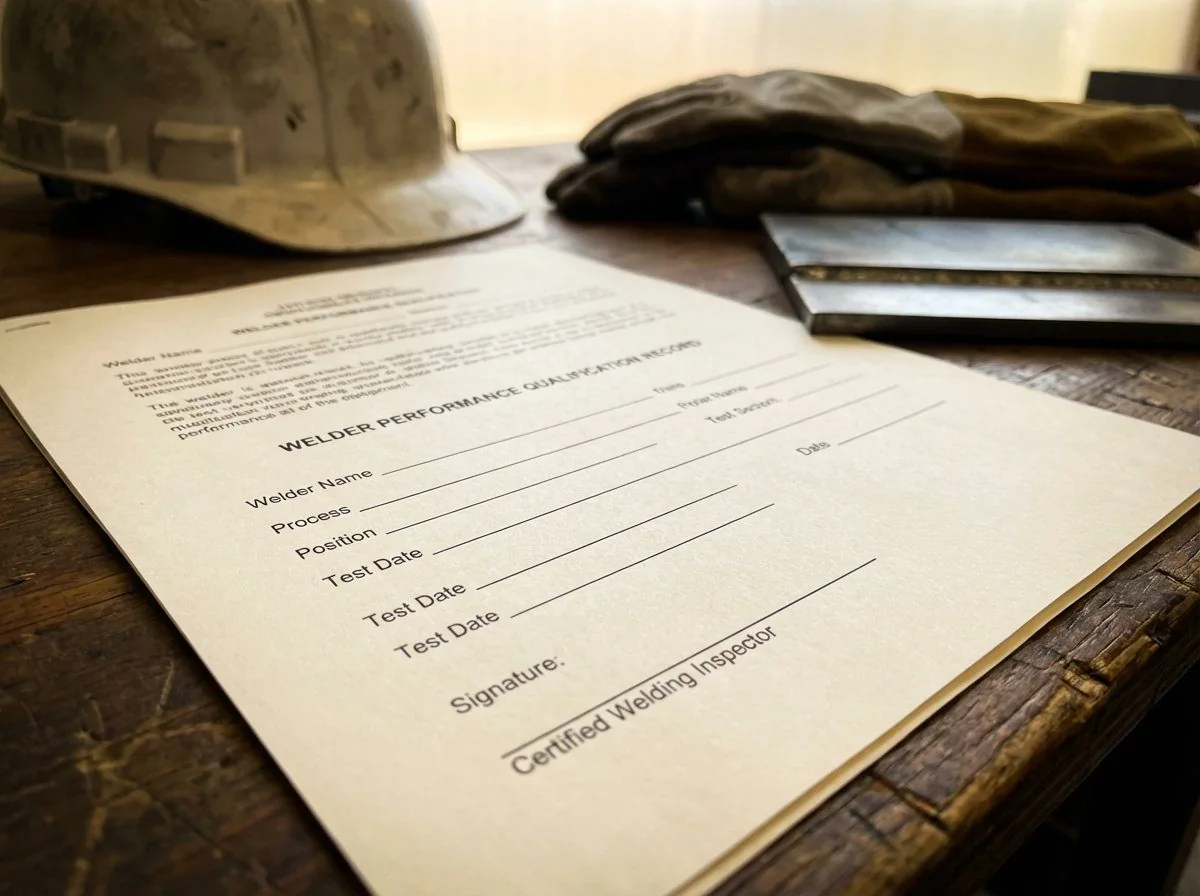
The AWS D1.1 6G pipe qualification covers every pipe welding position (1G through 6G groove plus all pipe fillet positions) on a single test. The pipe coupon is fixed at a 45-degree incline and cannot be rotated — the welder welds the full circumference through continuous compound angles. The 6G is always accepted in lieu of a 5G qualification. SMAW with E6010 root and E7018 fill/cap is the most common process combination. WeldCertTest performs all CWI inspection in Alpharetta, GA (Timothy Dodd, AWS CWI #00120381) and uses an accredited laboratory for bend testing. The result is an official WPQ record — not an AWS Certified Welder card, which is a separate program.
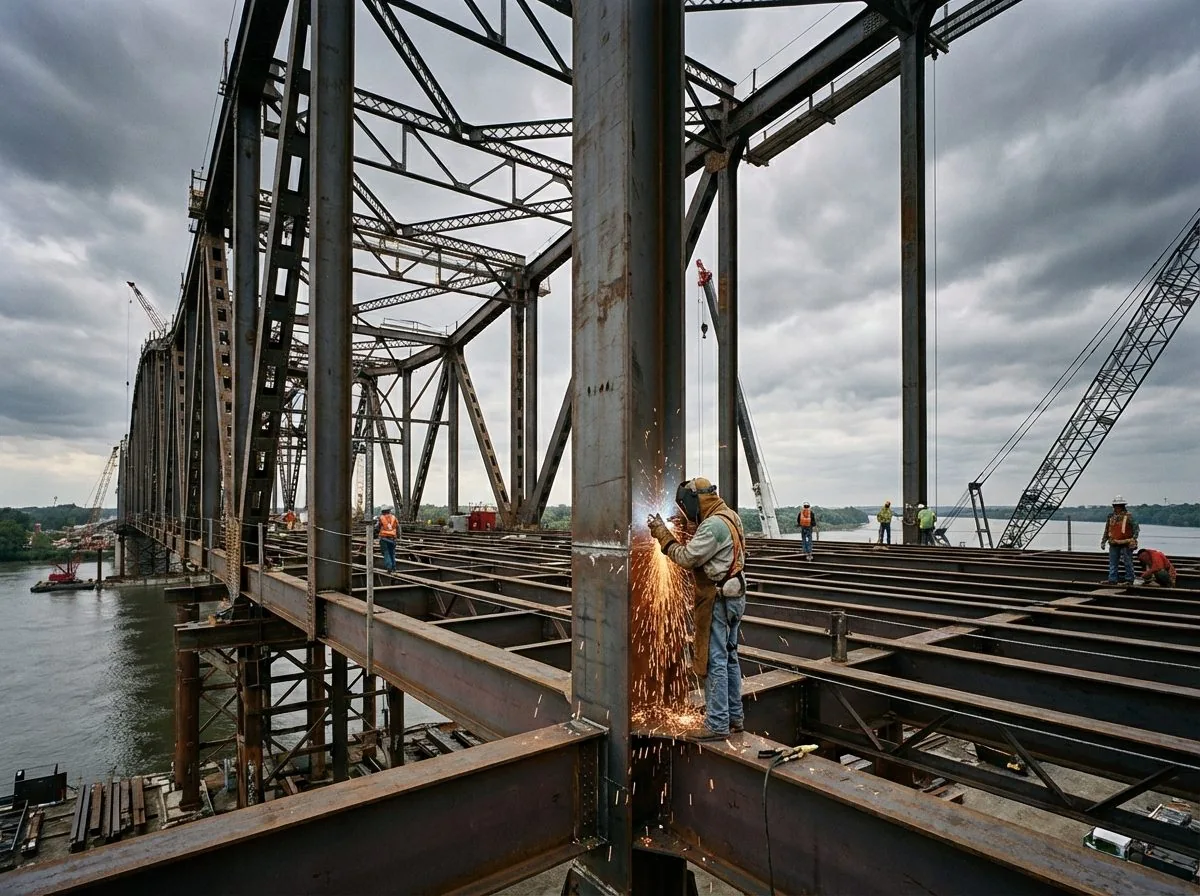
Why the 6G Is the Hardest Pipe Test
The 5G test is already demanding — pipe fixed horizontally, welder moves around through flat, vertical, and overhead. The 6G takes that and tilts everything 45 degrees. Now nothing is purely flat, vertical, or overhead. Every inch of every pass is a compound angle where the welder must simultaneously manage puddle control for two positions at once.
The hardest point on the 6G coupon is the overhead-to-flat transition zone at the top of the pipe. As the welder approaches the 12 o'clock position from either side, they're transitioning from near-overhead through a compound overhead-flat angle to flat — and the puddle behavior, ideal arc length, and travel speed all change within a few inches. Get comfortable with that transition zone before test day. It's where most 6G failures happen.
What the 6G Covers
One coupon, one test, everything. Per AWS D1.1, the 6G qualification covers all pipe welding positions:
| Test | 1G | 2G | 3G | 4G | 5G | 6G | All Fillets |
|---|---|---|---|---|---|---|---|
| 6G Pipe Test | ✓ | ✓ | ✓ | ✓ | ✓ | ✓ | ✓ |
| 5G Pipe Test | ✓ | ✗ | ✓ | ✓ | ✓ | ✗ | ✓* |
*5G fillet coverage excludes 2F horizontal fillet per D1.1 Table 6.10
Cost Considerations
The 6G is typically the most expensive single welder qualification test we perform — and for good reason. Pipe coupon material costs more than plate stock, the inspection process takes longer due to the full-circumference weld, and the bend specimen cutting and testing involves more specimens than a single-position plate test. Even so, the 6G is also one of the highest-value qualifications a welder can hold: it eliminates the need for separate 5G testing, qualifies all pipe positions, and is recognized by virtually every project specification that calls for pipe welder qualification.
Cost factors that affect 6G pricing:
- Pipe diameter and schedule — 8" Schedule 80 coupons cost more than 6" Schedule 80; larger diameters require more specimens for bend testing
- Process combination — GTAW root + SMAW fill/cap takes longer to inspect than SMAW E6010/E7018 alone
- Number of welders — contractors testing multiple welders typically receive volume pricing
- Expedited turnaround — standard turnaround vs. rush service if a job start is pending
- WPS provision — using your existing qualified WPS vs. having WeldCertTest provide one
Contact WeldCertTest at (404) 860-1288 or request a quote online for current pricing. We'll confirm process, pipe size, and turnaround before you commit to anything.
Test Coupon Specifications
The pipe coupon used for the 6G test must meet D1.1 requirements for material, diameter, and joint configuration. The specifications below represent standard 6G test parameters.
Welding Processes for 6G
Process selection on the 6G coupon matters — each process has different puddle characteristics that become amplified at the compound angles of the 6G position. The most successful 6G welders choose a process they know deeply, not just the one with the highest deposition rate.
SMAW — E6010 Root / E7018 Fill & Cap
- Most common combination for structural 6G pipe testing
- E6010 for root: forceful arc, fast freeze, bridges open root gap
- E7018 for fill and cap: low hydrogen, good puddle control
- E6010 requires DC+ polarity — confirm your machine before testing
- Store E7018 in rod oven — moisture causes hydrogen cracking
- Most universally accepted by structural and industrial contractors
GTAW Root / SMAW Fill & Cap
- Used where higher quality requirements apply
- TIG root produces the cleanest root bead geometry on pipe
- Root pass with GTAW then transition to SMAW E7018 for fill
- Slower overall — better for quality-critical applications
- More physically demanding in overhead portion of 6G
- Common in power generation, pressure vessel, and precision structural work
FCAW — Flux-Cored
- Higher deposition rate than SMAW — faster groove fill
- FCAW-G (gas-shielded) preferred in shop environments
- FCAW-S (self-shielded) for outdoor work where wind affects shielding
- More difficult to control at compound angles of the 6G position
- Slag removal around full pipe circumference requires more attention
- Viable for welders with extensive FCAW pipe experience
Process Selection Guidance
- Test on the process you use most in production
- Each process qualifies separately — SMAW cert doesn't cover FCAW
- SMAW E6010/E7018 is the safest choice for structural D1.1 testing
- GTAW root adds quality credibility — useful for industrial pipe work
- FCAW should only be used if you have extensive pipe experience with that process
- When in doubt, call us — we'll help you match the test to your production work
| Factor | SMAW E6010/7018 | GTAW + SMAW | FCAW |
|---|---|---|---|
| Open Root Control | Excellent | Best | Difficult |
| Overhead Puddle Control | Good | Moderate | Challenging |
| Deposition Rate | Moderate | Slow | High |
| Industry Acceptance | Universal | Universal | Check specs |
| Outdoor / Field | Yes | Limited | FCAW-S only |
| Best For | Most structural pipe | Quality-critical pipe | Experienced FCAW welders |
6G Technique — Moving Around the Pipe
The 6G is a full-circumference weld. The welder starts at the bottom (6 o'clock), moves up one side to the top (12 o'clock), then restarts at the bottom and moves up the other side. Every position transition happens within a single continuous weld — there is no stopping to re-setup between flat and overhead sections.
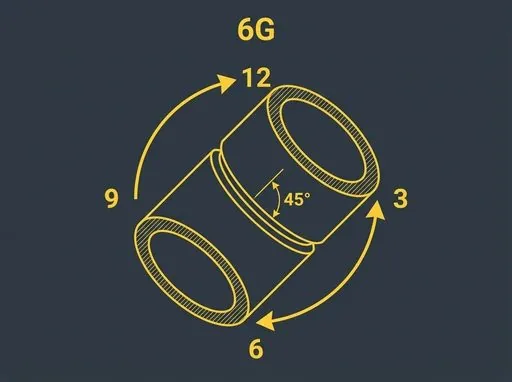
6 O'Clock — Bottom Start
- Begin both half-passes at the bottom of the pipe
- Tack welds at 3, 6, 9, and 12 o'clock positions — grind tack starts and stops flush
- Root pass: tight arc, watch for keyhole confirming full penetration
- Bottom zone is near-overhead on the 45° inclined pipe — treat it like overhead
- Establish your puddle and travel speed before reaching the critical transition zones
3 O'Clock / 9 O'Clock — Transition
- The side zones involve compound horizontal-vertical angles
- Adjust electrode angle continuously as you progress upward
- Work angle shifts from perpendicular toward pointing slightly uphill
- Puddle control is more stable here than at the extremes
- Maintain consistent travel speed — this zone tends to speed up naturally
- Interpass cleaning around the full circumference — don't skip the sides
12 O'Clock — The Critical Zone
- The most difficult transition on the 6G coupon
- Approaching 12 o'clock from each side involves moving from near-vertical through compound overhead-flat
- Reduce amperage slightly as you approach the top
- Keep arc length tightest here — puddle will sag if arc gets long
- The two half-passes meet at 12 o'clock — tie-in cleanly, no high spot
- Practice this transition specifically before test day
Root Pass — The Foundation
- E6010 for open root: aim at the root gap, travel speed controls keyhole size
- Watch the keyhole continuously — it confirms full penetration on the back side
- If keyhole closes, slow down; if it opens too wide, speed up
- Consistent root bead width = consistent bend test results
- Grind any high spots on the root pass before fill passes — they trap slag
- Root pass failure is the most common bend test failure on 6G coupons
Common 6G Test Failures
Incomplete Root Fusion at Transition Zones
The most common bend test failure. As the welder transitions through the compound angle zones, travel speed and arc length change — inconsistency at the transitions causes incomplete fusion in the root pass. Fix: Practice the full circumference continuously, not just the easy sections. The transition zones must be welded with the same deliberate arc control as the straightforward sections.
Poor 12 O'Clock Tie-In
Where the two half-passes meet at the top of the pipe is a common failure point — one side runs high, the other can't tie in cleanly, creating a cold lap or slag trap. Fix: Grind the end of the first half-pass flush before starting the second. Run the second half-pass into the first with slightly higher amperage to ensure full fusion at the tie-in point.
Arc Strikes Outside Weld Zone
Automatic visual rejection per D1.1 Clause 4.9 — no exceptions. More common on pipe than plate because the welder must reposition multiple times during a full circumference weld. Fix: Strike the arc inside the joint every time. Inspect the pipe surface adjacent to the weld carefully before shipping.
Slag Inclusions from Incomplete Interpass Cleaning
Welding around a full pipe circumference means chipping and brushing positions that are awkward — the bottom sections in particular. Incomplete slag removal at any point creates inclusions in the bend specimens. Fix: Take the time to chip and wire brush every pass on the full circumference before the next pass, including the sections you can't see easily.
Undercut at Cap Pass Toes
Undercut exceeding 1/32" at the weld toes is an automatic visual rejection before bend testing. On a pipe cap pass, undercut is most common in the transition zones where travel speed tends to increase. Fix: Run the cap pass with consistent, deliberate travel speed around the full circumference. Reduce amperage slightly from fill pass settings and pause briefly at each toe.
Inconsistent Root Gap
Pipe fit-up is harder than plate fit-up. A root gap that widens or narrows around the circumference causes inconsistent root fusion — tight spots don't fuse, open spots burn through. Fix: Check and verify the root gap at multiple clock positions before tacking. Use precision tack welds to lock the gap uniformly around the full circumference before beginning the root pass.
Visual Inspection Requirements
| Discontinuity | Limit | Notes |
|---|---|---|
| Cracks | None permitted | Any crack = immediate rejection |
| Incomplete fusion | None permitted | Anywhere in joint |
| Undercut | ≤ 1/32" (0.8mm) | Full circumference |
| Reinforcement | ≤ 3/16" (4.8mm) | Outside diameter surface |
| Arc strikes | None outside weld zone | Automatic rejection |
| Overlap | None permitted | Anywhere on circumference |
| Root concavity | ≤ 1/16" per D1.1 | Inside diameter surface |
Bend Testing the 6G Coupon
Coupons passing visual inspection proceed to accredited laboratory bend testing. Specimens are cut from specific clock positions around the pipe circumference to ensure the most difficult weld zones are tested. The number of specimens and their positions are specified by D1.1 based on pipe diameter.
Bend Specimen Cutting Pattern
Per AWS D1.1 Table 6.13, bend specimens are cut from specific clock positions on the pipe coupon. The locations are chosen to capture the most demanding weld zones — including the overhead-to-flat transition near 12 o'clock and the near-overhead region near 6 o'clock. For a typical 6" or 8" Schedule 80 pipe coupon, the test produces:
The specimens are cut so that the most critical weld zones — the transition regions where most 6G failures occur — are represented in the test sample. Reinforcement is machined flush on both the face and root surfaces before bending. Each specimen is bent 180 degrees around a mandrel of specified radius (per D1.1 Figure 6.7). The convex surface is then examined for cracks or open discontinuities. If any single specimen shows a discontinuity exceeding 1/8 inch in any direction, the qualification fails.
6G vs. 5G — Which Do You Need?
| Factor | 5G | 6G |
|---|---|---|
| Pipe Angle | Horizontal (0°) | Inclined (45°) |
| Positions Covered | 1G, 3G, 4G, 5G | All — 1G through 6G |
| 2G Horizontal Covered | No | Yes |
| All Fillet Positions | Partial | All |
| Difficulty | High | Highest |
| Accepted in lieu of 5G? | N/A | Yes — always |
| Gold standard credential | No | Yes |
| Best for | Specific pipe positions | All-position pipe work |
If the project spec requires 5G, the 6G satisfies it. If the project requires all-position pipe qualification, only the 6G covers everything. For welders planning a long career in structural or industrial pipe welding, the 6G is the credential worth earning once and maintaining.
6G AWS D1.1 vs. ASME Section IX / B31 Pipe Welding
This is one of the most-asked questions on the 6G test and one of the most consequential to get wrong. Here is the honest answer: an AWS D1.1 6G qualification does not automatically satisfy ASME Section IX, ASME B31.1, ASME B31.3, or API 1104 pipe welding requirements. They are separate codes with separate qualification requirements.
The industry-recognized distinction is simple: if a pipe carries a product (fluid, gas, slurry), the work falls under ASME B31, API 1104, or a similar pressure-piping or transmission code — and welders must be qualified under that code's qualification standard (typically ASME Section IX for pressure piping). If a pipe is purely structural (a column, brace, frame member, or hollow structural section that doesn't carry product), AWS D1.1 governs.
| Application | Code That Applies | 6G D1.1 Sufficient? |
|---|---|---|
| Structural pipe columns / braces | AWS D1.1 | Yes |
| HSS connections in steel frames | AWS D1.1 | Yes |
| Pipe hangers and supports | AWS D1.1 | Yes |
| Process piping (chemical plant, refinery) | ASME B31.3 + Section IX | No — separate qualification required |
| Power piping (steam, boiler) | ASME B31.1 + Section IX | No — separate qualification required |
| Pressure vessels / boilers | ASME Section IX | No — separate qualification required |
| Oil & gas pipelines | API 1104 | No — separate qualification required |
| Water transmission (AWWA) | AWWA C206 / AWS D1.1 | Often acceptable — verify with spec |
If your work involves both structural pipe and pressure piping, you may need to qualify under both codes. Some welders test once under conditions that meet both code requirements simultaneously (essential variables aligned), then receive two separate WPQ records. WeldCertTest offers ASME Section IX welder qualification as a separate service for pressure piping applications.
Mail-In Service — How It Works
-
Contact us for WPS and quote
Confirm the process (SMAW, GTAW root, FCAW) and pipe specifications. We provide a qualified WPS and pricing. If you have an existing D1.1 pipe WPS, you may use it.
-
Weld the 6G coupon at your facility
Your welder completes the full-circumference weld on the 45° fixed pipe coupon per the WPS. Proper fit-up, tacking, and interpass cleaning are all the welder's responsibility before shipping.
-
Ship the completed coupon
Follow our shipping instructions. Pipe coupons ship standard ground. Include welder name, process, and contact info with the shipment.
-
CWI visual inspection
Our AWS CWI performs full visual inspection of the completed coupon per D1.1 Clause 4.9. We contact you on any visual rejection before proceeding to bend testing.
-
Accredited bend testing
Specimens are cut from the required clock positions, prepared, and bent per D1.1 at our accredited testing laboratory. Full documentation of results.
-
WPQ issued and delivered
CWI signs and issues the official WPQ on passing. Delivered by email and mail. See timeframes for current turnaround.
How Much Experience Do You Need to Pass the 6G?
This is the question contractors and welders ask before committing money to a test. The honest answer: a welder coming straight from plate qualification — even with a solid 3G/4G in their pocket — will struggle on the 6G. Plate experience does not translate directly to pipe. The compound angles, full-circumference travel, and open root requirements are different skills.
Realistic Prep Expectations
Strong Plate Welder, No Pipe Experience
Expect 30+ hours of pipe practice before attempting 6G. Start with rotated pipe (1G) to learn the joint, then 2G fixed-vertical pipe, then 5G horizontal-fixed, then 6G. Skipping steps almost guarantees failure on a paid test.
Experienced 5G Pipe Welder
Realistic timeline is 8–15 hours of dedicated 6G practice. The 5G covers most of the muscle memory; the 6G adds compound angles and the 12 o'clock transition. Focus practice time on the transition zones and on tying in the two half-passes cleanly at 12 o'clock.
Pipefitter / Field Pipe Welder
If you weld pipe daily in real production, you may need just 4–8 hours to refresh on test-specific essentials: WPS compliance, tack placement, root pass keyhole consistency, and clean tie-ins at the top. Don't skip practice on the actual joint configuration we'll inspect.
Returning Welder (Cert Lapsed)
If your 6G lapsed under the 6-month continuity rule, plan on 6–12 hours of refresher practice. Skill comes back faster than it builds — but the test is still pass-fail on bend specimens, not effort. Don't shortcut the prep.
Industries That Require the 6G Qualification
Structural Steel Contractors
Pipe columns, HSS connections, round hollow structural sections in steel frames — all require pipe qualification on D1.1 projects. The 6G is specified by name on high-value structural steel contracts.
Industrial Piping
Process piping in refineries, chemical plants, and power generation facilities involves pipe in every orientation. The 6G credential is widely required for maintenance and construction welders on these projects.
Shipbuilding and Marine
Shipyard pipe welders work in confined spaces with pipe in non-ideal orientations. The 6G qualification provides the positional versatility required for hull and systems piping work.
Heavy Construction
Bridge construction, stadiums, industrial facilities, and large commercial projects involving structural pipe connections frequently require 6G-qualified welders by project specification.
The Career Value of a 6G Qualification
The 6G is widely recognized as the most valuable single welder credential in structural and industrial pipe welding. Welders who hold a current 6G WPQ have demonstrably broader job options than welders with plate-only qualifications. Project specifications calling for 6G by name appear regularly on bid documents for power plants, refineries, shipyards, and structural steel projects with significant pipe content.
Reasons the 6G is treated differently in the labor market:
- Universal pipe coverage — one credential, every pipe position, no follow-up tests needed
- Demonstrated skill ceiling — passing 6G proves a level of arc control that translates to almost any other weld scenario
- Supply / demand — fewer welders hold a current 6G than hold plate qualifications; the credential is scarcer
- Cross-industry portability — the same 6G WPQ is recognized by structural, industrial, marine, and energy contractors
- Higher-paying job pools — premium industrial work (refinery turnarounds, power plant maintenance, shipyard pipe) typically calls for 6G qualification
For an individual welder weighing the investment of test time and money, the 6G typically opens doors that the 3G/4G plate qualification alone does not — especially in industrial, energy, and marine sectors. For a contractor staffing a project, a crew of 6G-qualified welders eliminates the position-coverage uncertainty that plate-only crews can create.
Certification Validity — The 6-Month Rule
Per AWS D1.1 Clause 6.4.1, the 6G qualification is valid indefinitely as long as the welder uses the qualified welding process at least once every six months and the employer documents it. If more than six months passes without using the process, the qualification expires and retesting is required.
Glossary
Pipe fixed at 45-degree incline, welder moves around the full circumference. The most comprehensive and demanding pipe qualification position under AWS D1.1.
Root pass welded from the outside of the pipe only, with no backing ring. The welder must achieve full penetration and a sound root bead on the inside surface from the outside alone.
Cellulosic SMAW electrode preferred for open root pipe passes. Produces a forceful, penetrating arc that bridges the root gap and freezes quickly — ideal for overhead and inclined pipe root welding.
The small hole visible ahead of the weld puddle during open root pipe welding. Confirming a consistent keyhole throughout the root pass verifies full penetration and a sound root bead.
Reference positions around the pipe circumference described as clock face positions — 12 o'clock (top), 6 o'clock (bottom), 3 and 9 o'clock (sides). Used to identify weld locations and bend specimen cutting positions.
Welder Performance Qualification record — the official CWI-signed document certifying the welder passed the 6G test. Lists positions covered, process, pipe size, and thickness range qualified.
Pipe fixed horizontally, welder moves around it. Less comprehensive than 6G — does not cover 2G horizontal or the compound angles of the 6G position. A 6G qualification supersedes 5G.
A weld position that combines elements of two standard positions simultaneously — for example, overhead-flat or vertical-horizontal. The 6G's 45-degree incline creates compound angles throughout the full circumference.
Frequently Asked Questions
What positions does the 6G qualification cover?
Why is the 6G the hardest pipe test?
What is the difference between 5G and 6G?
Does the 6G cover plate welding positions?
What is the best process for the 6G test?
What is the most common failure on the 6G test?
Can I mail in my pipe coupon for testing?
How long does the 6G certification stay valid?
What if the welder fails the 6G test?
Do I need a WPS for the 6G test?
Can a 6G qualification be used at a new employer?
Does an AWS D1.1 6G qualification satisfy ASME Section IX or B31 pipe welding requirements?
How much practice do I need before taking the 6G test?
How are bend specimens cut from a 6G pipe coupon?
The People Behind the Inspection
Every coupon submitted to WeldCertTest is inspected by a named, currently-certified AWS CWI. When a project inspector asks who signed your WPQ, you have an answer.


Ready to Qualify for All-Position Pipe Welding?
Mail-in service. CWI inspected. Official WPQ issued. Nationwide.