AWS D1.7 Structural Strengthening & Repair Welder Qualification
Mail-in AWS D1.7 welder qualification for structural repair and strengthening contractors — bridge repair, building retrofits, and industrial structure reinforcement. Ship your test coupon to Atlanta. We handle CWI inspection, accredited bend testing, and official WPQ documentation.
✓ We Test Your Coupons • ✗ We Are Not a Welding School • ✓ Official WPQ Records Issued
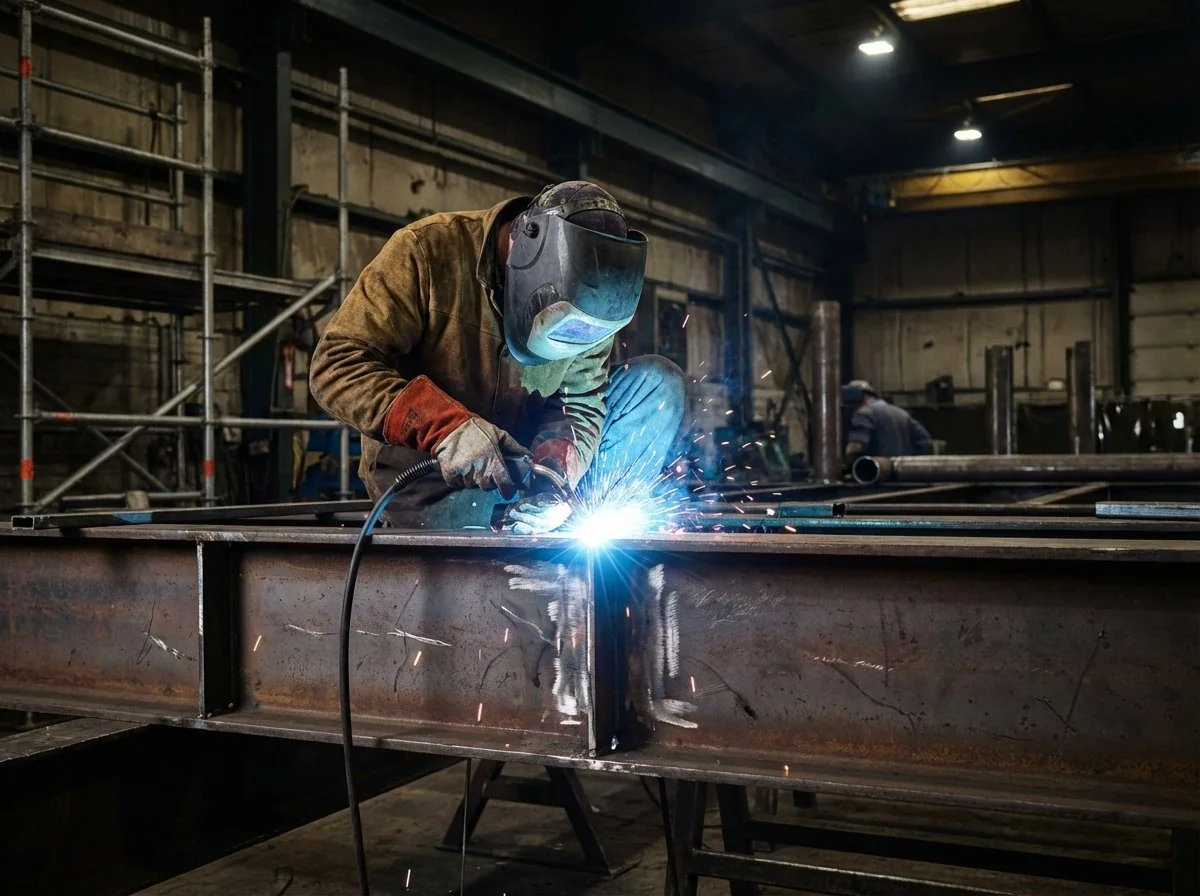
What Is AWS D1.7 and Who Needs This Qualification?
AWS D1.7, Guide for Strengthening and Repairing Existing Structures, addresses one of the most technically demanding areas of structural welding — working on steel that already exists in a loaded structure. Unlike new construction where you start with known materials and work to a design in a controlled environment, repair welding involves:
- Base metal of unknown or partially known chemistry — often older steels from pre-standardization eras
- Structures that may be in service and carrying load while repairs are being made
- Pre-existing damage — cracks, corrosion, impact damage — that must be addressed before welding
- Restricted access positions and tight work spaces that make positioning and technique difficult
- Higher preheat requirements due to conservative assumptions about unknown steel chemistry
- Post-weld inspection requirements that may include NDT on completed repair welds
Welders performing repair and strengthening work under AWS D1.7 specifications must hold appropriate qualification. This applies to:
- Bridge repair contractors working on existing steel truss, girder, and connection repair
- Building retrofits and seismic upgrades where existing steel frames are strengthened
- Industrial facility maintenance welders performing structural repairs on cranes, platforms, and equipment supports
- Infrastructure repair contractors on steel utility structures, towers, and marine structures
- General contractors performing structural steel repairs under engineer-specified D1.7 requirements
AWS D1.7 vs. AWS D1.1 — What Changes in Repair Work
| Factor | AWS D1.7 (Repair) | AWS D1.1 (New Construction) |
|---|---|---|
| Base Metal Knowledge | Often unknown — investigation required | Known — specified on drawings |
| Structure Loading | May be in-service during repair | Unloaded during fabrication |
| Pre-existing Defects | Cracks, corrosion — must be addressed | Not applicable — new material |
| Preheat | Conservative — often higher for unknown steels | Per D1.1 Table 3.2 based on known CE |
| Access | Often restricted — overhead, tight spaces | Generally open access in fabrication environment |
| Welder Qualification | D1.1 procedures by reference | Self-contained in D1.1 |
| NDT Requirements | Often more extensive post-repair | Per D1.1 inspection criteria |
| Documentation | Repair procedure + WPQ required | WPS + PQR + WPQ required |
AWS D1.7:2024 — Current Edition Status
The 2024 edition is a substantial expansion of the original 2010 guide. Authority points for project teams:
- D1.1:2025 cross-references D1.7:2024 by name. AWS D1.1/D1.1M:2025 explicitly references D1.7:2024 as the authoritative companion guide for strengthening and repair. When D1.1 Clause 11 (Strengthening and Repair of Existing Structures) applies to a project, D1.7:2024 is the referenced guidance document
- Expanded scope beyond welded repair. The 2024 edition covers welded repairs, heat-assisted straightening, fatigue improvements (toe grinding, dressing, hammer peening of existing welds), and non-welded related repairs including partial or complete member replacement
- Three explicit base material categories — see the section below on cast iron and wrought iron coverage
- Engineer-driven approach. D1.7 is structured as guidance for the engineer of record obligated under D1.1 Clause 11. The engineer develops the repair plan; D1.7 provides the technical framework
AWS D1.7 Covers Three Base Materials — Including Cast Iron and Wrought Iron
This is a content area many fabricators and contractors miss: AWS D1.7:2024 explicitly applies to three distinct base material categories, not just modern structural steel.
1. Carbon & Low-Alloy Steel
Minimum specified yield strength of 100 ksi (690 MPa) or less. Covers modern ASTM structural steel (A36, A572, A992, A588) and the older steels found in bridges, buildings, and industrial structures dating back into the early 20th century. The majority of D1.7 production work falls in this category.
2. Cast Iron
Repair welding on existing cast iron components — common in historic building column restoration, ornamental architectural ironwork, industrial machinery bases, antique press and equipment frames, and historic bridge bearing components. AWS D11.2, Guide for Welding Iron Castings, is the companion document for the underlying metallurgy and weldability of cast iron.
3. Wrought Iron
The primary material of pre-1900 truss bridges. Wrought iron predates standardized steel and has its own weldability characteristics (very low carbon, slag inclusions inherent to the material, layered grain structure). Historic bridge restoration — both vehicular and pedestrian — runs into wrought iron constantly. D1.7:2024 is now the AWS authoritative document for wrought iron repair welding.
The Unique Challenges of Structural Repair Welding
Unknown Base Metal
Steel manufactured before the 1970s may not conform to modern ASTM standards. Carbon and sulfur content can be significantly higher than modern specifications. Higher carbon equivalent means higher cracking risk and higher required preheat. AWS D1.7 provides procedures for investigating and testing existing base metal chemistry before developing the repair WPS.
In-Service Loading
When a structure is in service during repairs, weld shrinkage stresses add to existing service stresses. This can cause cracking in weld metal or base metal that would not occur in an unloaded condition. AWS D1.7 requires repair sequence planning that accounts for live loads and specifies how to manage weld sequence and load reduction where possible.
Crack Excavation
Pre-existing cracks must be completely removed before repair welding — stop-hole drilling is not acceptable for weld repair. The entire crack must be excavated to sound metal, confirmed by MT or PT inspection, and then weld repaired from the excavated position. Incomplete crack removal is the most common cause of repair weld failure.
Preheat Management
Preheat for repair work on unknown steels is typically set conservatively — often 300°F or higher for older high-carbon steels. Maintaining preheat in the field, especially in cold weather on overhead or vertical welds, requires constant monitoring with contact thermometers or temp sticks. Preheat failure is the leading cause of hydrogen cracking in repair welds.
Preheat Requirements for Repair Welding on Existing Structures
When base metal chemistry is unknown, AWS D1.7 provides conservative preheat guidance. These are general guidelines — the engineer of record establishes actual preheat requirements based on investigation results:
| Steel Era / Type | Likely Carbon Equivalent | Conservative Preheat | Notes |
|---|---|---|---|
| Modern structural (post-1970) | CE ≈ 0.40–0.45 | Per D1.1 Table 3.2 | ASTM A36, A572 — follow standard D1.1 preheat tables |
| Mid-20th century steel | CE possibly 0.45–0.55 | 200–300°F | Higher carbon possible — conservative preheat recommended |
| Early 20th century / rivet era | CE potentially 0.55+ | 300–400°F | Pre-ASTM steel — chemical testing strongly recommended |
| Unknown — no markings | Unknown | 350°F minimum | Most conservative approach until chemistry is established |
| High-strength (A514, A709) | CE 0.40–0.65 | Per D1.1 Table 3.2 for grade | Requires low-hydrogen filler — critical for H-4 or H-8 designation |
Strengthening vs. Repair — Understanding the Difference
AWS D1.7 covers two distinct applications that require different approaches:
Repair
Restoring an existing structural member to its original design capacity after damage, deterioration, or defect. Examples: repairing fatigue cracks in bridge girder webs, welding over corroded sections on industrial platform framing, fixing impact damage on a crane girder. The goal is to restore original capacity — not to increase it.
Strengthening
Increasing the load-carrying capacity of an existing structural member beyond its original design capacity. Examples: welding cover plates to existing beam flanges for a higher load rating, adding stiffeners to existing plate girder webs, welding reinforcing channels to existing columns for seismic retrofit. Strengthening requires a complete engineering analysis by a licensed structural engineer.
NDE Requirements for Repair Welds
Repair weld quality verification often goes beyond visual inspection. Common NDE methods for D1.7 repair work:
- Magnetic Particle Testing (MT) — Most common for surface and near-surface crack detection in ferritic steel repair welds. Required after crack excavation to confirm complete removal and often required on completed repair welds in fatigue-critical locations.
- Penetrant Testing (PT) — Used where MT is not applicable. Detects surface-breaking discontinuities. Used on stainless steel repairs and non-magnetic materials.
- Ultrasonic Testing (UT) — Subsurface detection in thicker plate repair welds. Required on fatigue-critical bridge repairs and high-stress connections.
- Radiographic Testing (RT) — Sometimes specified for complete joint penetration repair welds where full volumetric inspection is required. Less common than UT for repair work due to access limitations.
AWS D1.7 vs. Other AWS Codes — Where D1.7 Fits in Repair Work
D1.7 is unique in the AWS D1 family — it is a guide rather than a standalone qualification code, and it intentionally references other codes for the technical requirements they handle better. Here is the applicability map for repair welding on existing structures:
| Repair Application | Primary Code / Guide | Welder Qualification Basis |
|---|---|---|
| Existing carbon/low-alloy steel structural repair (buildings, industrial) | AWS D1.7 (guide) + AWS D1.1 (qualification) | D1.1 WPQ |
| Cast iron repair welding (historic, machinery, ornamental) | AWS D1.7 + AWS D11.2 (cast iron weldability) | D1.1 WPQ + process-specific |
| Wrought iron historic restoration (pre-1900 truss bridges, etc.) | AWS D1.7 | D1.1 WPQ + engineer-specified |
| Highway / railroad bridge repair under state DOT jurisdiction | AASHTO/AWS D1.5 Bridge Welding Code + D1.7 guidance | D1.5 WPQ (DOT-specified) or D1.1 WPQ |
| Stainless steel structural repair | AWS D1.6 + D1.7 guidance | D1.6 WPQ |
| Sheet steel structural repair (decking, light gauge) | AWS D1.3 + D1.7 guidance | D1.3 WPQ |
| Pressurized piping repair | ASME B31.3 / B31.1 + Section IX | ASME IX WPQ |
| Pipeline repair (oil/gas transmission) | API 1104 | API 1104 WPQ |
| Reinforcing steel structural repair | AWS D1.4 + D1.7 guidance | D1.4 WPQ |
Real-World D1.7 Production Repair Scenarios
D1.7 applies to a wide range of structural repair and strengthening production work. These are the most common contexts where the qualification, repair procedure, and CWI documentation are verified by engineers, owners, and inspectors:
Bridge Fatigue Crack Repair
Fatigue crack arrest and repair on highway and railroad bridge girders. Crack excavation to sound metal, MT/UT verification, low-hydrogen repair welding, post-weld grinding and re-inspection. Most common single D1.7 production scenario. Often involves traffic-mounted live load during welding.
Historic Wrought Iron Restoration
Pre-1900 truss bridge restoration — vehicular bridges, pedestrian bridges, rail trestles. Wrought iron has distinct weldability characteristics from steel. Often involves historic preservation oversight (state SHPO, federal HABS/HAER documentation). D1.7:2024 is the explicit AWS authority for this work.
Cast Iron Column & Ornamental
Cast iron column repair in historic commercial buildings (loft conversions, mixed-use restoration), ornamental architectural cast iron, antique industrial machinery base repair. Cast iron has its own weldability challenges — D1.7 sets the procedural framework, D11.2 covers the metallurgy.
Crane Girder & Runway Repair
Industrial overhead crane girder repair after impact damage, fatigue cracking in box girder welds, crane runway beam corrosion buildup repair. Often in-service repair work where the crane is shut down briefly but the building stays operational. Strict procedure discipline; engineer-stamped repair plan.
Building Seismic Retrofit
Welded reinforcement of existing steel building frames for updated seismic code compliance — cover plates on existing beams, doubler plates on connections, brace member additions, column reinforcement. Common in California, Pacific Northwest, and New Madrid zone retrofit programs. The 2024 D1.7 scope now also covers heat-assisted straightening of distorted members.
Marine & Industrial Infrastructure
Corroded structural member repair on marine platforms, port and dock infrastructure, transmission towers, water tank framing, and industrial platform structures. Weld build-up of corroded sections, member replacement, and reinforcement. The 2024 edition now explicitly covers non-welded member replacement procedures alongside welded repair.
AWS D1.7 Structural Repair Welder Qualification — FAQ
What is AWS D1.7 and who needs welder qualification under this standard?
How is AWS D1.7 different from AWS D1.1?
Can a structural repair welder use their existing D1.1 qualification for D1.7 work?
Why is repair welding on existing structures more challenging than new construction?
What is preheat and why is it critical for structural repair welding?
What positions does AWS D1.7 welder qualification cover?
What NDE is typically required on structural repair welds?
What is the difference between repair and strengthening under AWS D1.7?
What documentation is issued after passing AWS D1.7 welder qualification?
Does AWS D1.7 allow mail-in welder qualification testing?
What are essential variables for AWS D1.7 repair welder qualification?
What edition of AWS D1.7 is currently in effect?
Does AWS D1.7 cover cast iron and wrought iron repair?
Does AWS D1.7 apply to bridge repair work, and how does it interact with the bridge welding code?
What kinds of production welding actually require AWS D1.7 compliance?
Does an AWS D1.7 qualification produce a WPQ record or an AWS Certified Welder card?
Structural Repair Welding — Key Terms
- AWS D1.7
- Guide for Strengthening and Repairing Existing Structures. An AWS publication providing guidance and requirements for welding on existing steel structures, addressing the unique technical challenges of repair work.
- Carbon Equivalent (CE)
- A calculated value representing steel hardenability based on chemical composition. Higher CE = higher preheat required to prevent hydrogen cracking. For unknown steels, CE must be estimated conservatively from mill records or established by chemical testing.
- Fatigue Crack
- A crack initiated and propagated by cyclic loading over time. Common in bridge structures, crane girders, and industrial structures subject to repeated loading. Must be fully excavated before repair welding — incomplete removal results in continued crack propagation.
- Hydrogen-Induced Cracking (HIC)
- Cracking caused by diffusible hydrogen trapped in the weld or HAZ during cooling. Prevented by using low-hydrogen filler metals, maintaining adequate preheat, and limiting moisture exposure of electrodes. The primary cracking mechanism in repair welds on high-carbon or unknown steels.
- Magnetic Particle Testing (MT)
- A non-destructive examination method that detects surface and near-surface cracks in ferromagnetic materials by applying a magnetic field and iron powder. Commonly required after crack excavation to confirm complete removal and on completed repair welds in critical locations.
- Preheat
- Heat applied to the base metal before welding to reduce the cooling rate and minimize hydrogen cracking risk. For repair work on unknown steels, preheat is set conservatively — often 300°F or higher — until steel chemistry is established.
- Strengthening
- Increasing the load-carrying capacity of an existing structural member beyond its original design capacity through the addition of welded reinforcement. Requires licensed structural engineering analysis and design before any welding work begins.
Reviewed by the People Behind the Inspection
Every page on this site is reviewed by the people performing the actual qualification work — not anonymous content writers.

Timothy Dodd
AWS CWI #00120381 • ICC S2 #8184186
AWS Certified Welding Inspector. Performs all CWI visual inspection for WeldCertTest welder qualification testing. Reviews technical content for code accuracy. Owner of Xenogenesis, LLC.
Roger Baldwin
Site Owner & Operator
Owner and operator of WeldCertTest.com. 28 years in the broader nondestructive testing industry. Handles business operations; partners with Timothy Dodd for all CWI inspection and technical content review.
Ready to Qualify Your Structural Repair Welders?
Mail your test coupon. We handle CWI inspection, accredited bend testing, and issue the official WPQ. Structural repair contractors nationwide trust WeldCertTest.
Content reviewed by Timothy Dodd, AWS CWI #00120381 · Last reviewed May 16, 2026