What Is the 2G Plate Qualification?
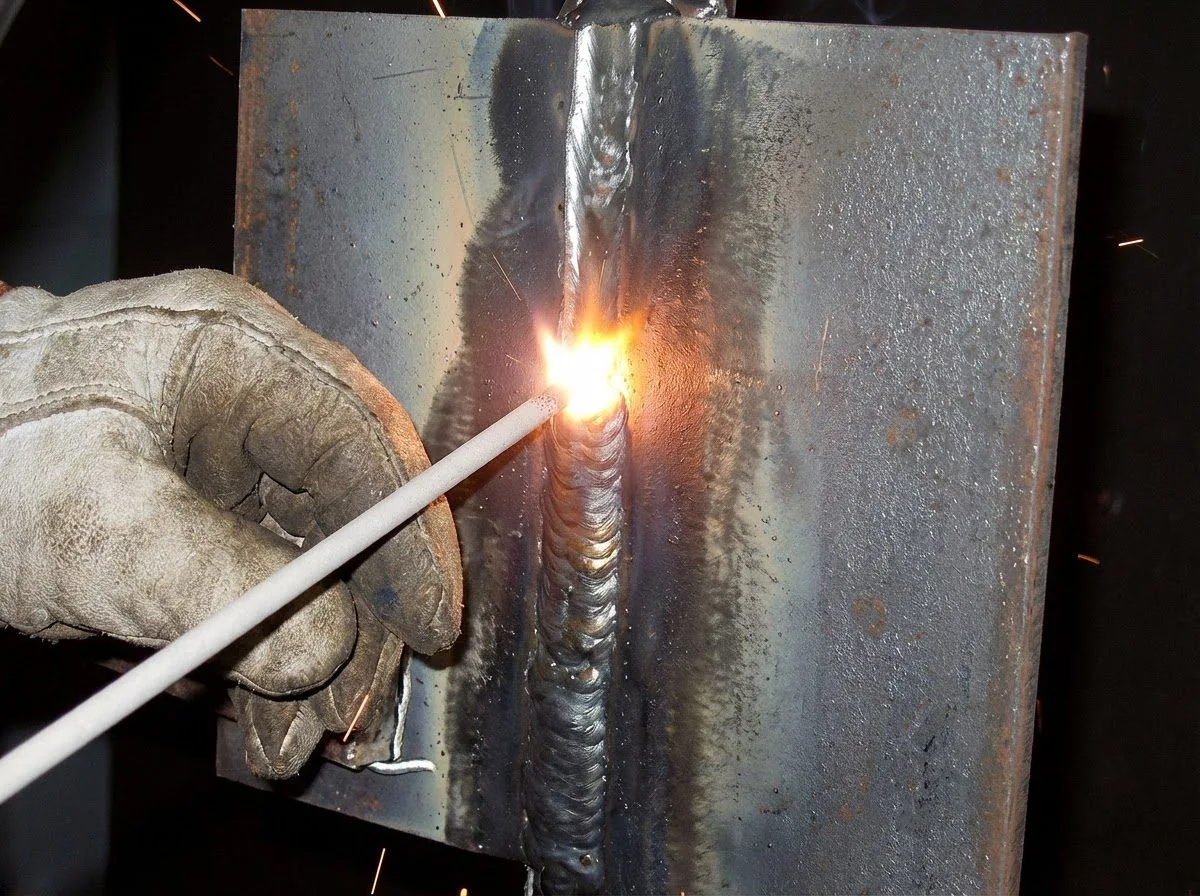
The AWS D1.1 2G plate qualification is a Complete Joint Penetration (CJP) groove weld test with the plate positioned vertically and the weld axis running horizontally. The "2" designates horizontal position. The "G" designates groove weld.
Horizontal welding introduces gravity as a real variable — the molten puddle wants to sag downward off the lower plate edge and undercut the upper plate edge simultaneously. Managing both tendencies through consistent travel speed, arc length, and electrode angle is what the 2G test measures. It is not the most technically demanding plate position, but it catches welders who rely on gravity helping them rather than fighting it.
The AWS D1.1 2G horizontal plate qualification covers flat (1G) and horizontal (2G) groove welds plus 1F and 2F fillet welds per Table 6.10. It does not cover vertical (3G) or overhead (4G) positions — those require separate tests or the combined 3G/4G qualification. Test on a 1-inch ASTM A36 plate for unlimited thickness qualification. One test plate, four bend specimens, single V-groove CJP with 45° included angle, 1/4" root opening, and 1/4"×1" A36 backing bar. The 2G is the most common qualification for shop fabrication of horizontal pressure vessel seams, tank shell-to-shell welds, and bridge girder flange-to-web welds. WeldCertTest performs all CWI inspection in Alpharetta, GA (Timothy Dodd, AWS CWI #00120381). The result is an official WPQ record — not an AWS Certified Welder card, which is a separate program.
What the 2G Qualifies You For
The 2G horizontal test qualifies the welder for groove and fillet welds in the flat and horizontal positions per AWS D1.1 Table 6.10. It does not cover vertical or overhead positions.
| Weld Type | 1G Flat | 2G Horiz. | 3G Vert. | 4G OH | 1F | 2F | 3F | 4F |
|---|---|---|---|---|---|---|---|---|
| 2G Groove Test | ✓ | ✓ | ✗ | ✗ | ✓ | ✓ | ✗ | ✗ |
Should You Test 2G or Go Straight to 3G?
This is worth thinking through before you order a test. The 3G vertical qualification covers everything the 2G covers — flat and horizontal — plus vertical. The cost difference between a single 2G test and a single 3G test is typically minimal. If there is any chance your welders will ever need vertical qualification, it makes more sense to test the 3G and be done with it.
| Test | Flat | Horizontal | Vertical | Overhead | Plates |
|---|---|---|---|---|---|
| 2G Horizontal | ✓ | ✓ | ✗ | ✗ | 1 |
| 3G Vertical | ✓ | ✓ | ✓ | ✗ | 1 |
| 3G/4G All-Position | ✓ | ✓ | ✓ | ✓ | 2 |
The 2G makes sense when a specific project or employer qualification requirement lists horizontal only, or when a welder already holds a 3G and needs to demonstrate the horizontal position separately for a particular quality program. For general structural fabrication, the 3G covers more ground for the same number of test plates.
Cost Considerations — The 2G's Pricing Awkward Spot
The honest commercial picture for the 2G: it sits in an awkward middle ground. Pricing is similar to a 1G flat plate test but covers more (adds horizontal). Pricing is similar to a 3G vertical test but covers less (no vertical). For welders whose work is genuinely horizontal-only — pressure vessel circumferential welds, horizontal tank shell seams, certain bridge girder details — the 2G is the right answer at the right price. For most other scenarios, doing the math usually points to either the 1G (cheaper, if flat-only work) or the 3G (similar cost, broader coverage).
Decision factors:
- Project spec calls for 2G specifically — get the 2G. Some specs name the position explicitly and substitutions are not accepted.
- Production is genuinely flat-and-horizontal-only — pressure vessel shop, horizontal seam fabrication. The 2G covers the work without overpaying for vertical/overhead coverage you won't use.
- Adding horizontal to an existing 1G welder — single 2G test gives them flat+horizontal. Pragmatic if the 3G would be a stretch.
- General structural fab work — go straight to the 3G. Same number of plates, qualifies vertical too.
- Any field work at all — 3G/4G combined. Field welds happen in every position, not just horizontal.
Contact WeldCertTest at (404) 860-1288 or request a quote online to discuss your specific application. We'll confirm whether the 2G is the right test for your work or whether you'd be better served by the 1G, 3G, or 3G/4G — without trying to upsell into more coverage than your operation actually needs.
Test Plate Specifications
Thickness Qualification
| Test Plate | Min Production | Max Production | Use This? |
|---|---|---|---|
| 3/8" (9.5mm) | 1/8" | 3/4" max | Light fab only |
| 1" (25mm) | 1/8" | Unlimited | Yes — always |
Welding Technique — Horizontal Position
The 2G horizontal position is where gravity first becomes an active problem. On the 1G flat, gravity compresses the puddle against the base metal. On the 2G horizontal, gravity pulls the puddle perpendicular to the joint — constantly trying to sag it off the lower plate edge and undercut the upper plate edge. The welder's response is heat control and travel speed, not position changes.
Heat Control Discipline Is the Unifying Skill
Every technique decision on the 2G ladders up to the same question: how do I keep the puddle small, fast, and pinned against the upper plate? The answer is always heat. Less heat than a 1G flat run — typically 5 to 10 percent lower amperage. Faster travel speed than would feel right. Tighter arc length. Stringer beads exclusively, no weaving. Slight upward work angle. Every technique card below is a different expression of the same principle: control heat, control the puddle, pass the test.
Welders coming from 1G flat work who treat the 2G as "just turn the plate sideways" almost always fail the first time. The heat that worked on flat will sag the puddle on horizontal. The technique that worked on flat will leave undercut on horizontal. The 2G rewards welders who recalibrate their heat input deliberately before the first arc strike.
Electrode Angle — Horizontal
- Work angle: 5°–10° upward (toward upper plate) to counteract puddle sag
- Travel angle: 5°–15° in the direction of travel
- The slight upward work angle deposits metal against the upper plate — prevents undercut
- Keep the arc aimed at the upper half of the joint, not the center
- If puddle starts sagging, increase angle upward and increase travel speed
- Consistent angle throughout the pass — don't let the wrist drift
Travel Speed and Heat Control
- Faster travel speed = less heat = less sag — the 2G rewards speed over hesitation
- Reduce amperage 5–10% below flat position settings
- Stringer beads throughout — no weaving on horizontal groove welds
- Watch the upper toe continuously — undercut shows up there first
- Each stringer should be narrow and slightly convex — flat or concave will sag
- Allow brief interpass cooling to prevent heat buildup across multiple passes
Root Pass
- First pass most critical — establishes the foundation for all fill passes
- Aim at the root opening, not the backing bar face
- Narrow root bead is correct — wide root pass creates a shelf that traps slag
- Grind any high spots before fill passes
- Slightly higher amperage on root than fill — need full fusion at the backing bar
- Don't stop mid-pass — restarts on horizontal create cold lap potential
Cap Pass
- Reinforcement must stay under 3/16" above base metal surface
- Tie tightly into both toes — top edge undercut is the most common visual failure
- Run the cap slightly hotter than fill if needed to ensure toe fusion
- Consistent travel speed end to end — stopping creates a high spot
- After welding, inspect upper plate edge carefully before shipping
- Check for arc strikes on base metal adjacent to weld zone
Welding Processes for the 2G Test
The 2G horizontal position is manageable with all common structural welding processes. The horizontal position does not impose the same process restrictions as the 4G overhead — most experienced welders can pass the 2G with their preferred process.
| Process | Puddle Control | Acceptance | Notes |
|---|---|---|---|
| SMAW E7018 | Excellent | Universal | Best choice for structural testing |
| FCAW-G | Good | Universal | Higher deposition, check project specs |
| FCAW-S | Good | Check specs | Self-shielded, field applications |
| GMAW | Good | Check specs | RT cannot sub for bends on GMAW-S |
Common 2G Test Failures
Undercut on the Upper Plate Edge
The most common visual failure on the 2G. The arc burns into the upper plate edge and the puddle doesn't fill back in — leaving a groove along the top toe of the weld. Cause: amperage too high, arc length too long, or work angle pointing too far upward. Fix: reduce amperage 5–10%, shorten arc length, maintain a slight upward work angle (not steep), and keep travel speed consistent.
Puddle Sag and Overlap on Lower Plate
Molten weld metal flows off the lower plate edge, solidifies over the base metal surface — automatic visual rejection. Cause: amperage too high, travel speed too slow, arc length too long. Fix: increase travel speed, reduce amperage, keep stringers narrow. The moment you see the puddle getting wide and fluid, speed up.
Incomplete Root Fusion
Most common bend test failure — root pass didn't fully tie into the backing bar. Cause: insufficient heat on root pass, arc too far from root opening, or travel speed too fast through tight sections. Fix: use slightly higher amperage on root than fill, aim arc directly at the root opening, verify consistent 1/4" gap before starting.
Slag Inclusions Between Passes
Incomplete interpass cleaning on horizontal joints — the slag shelf that forms on the lower bead surface doesn't get fully removed before the next pass. Fix: chip and wire brush every pass thoroughly, paying specific attention to the lower edge of each stringer where slag accumulates. Use a grinder on any tight slag in corners.
Arc Strikes Outside Weld Zone
Automatic visual rejection per D1.1 Clause 4.9 — no exceptions. Any arc strike on the plate surface adjacent to the weld zone must be removed and the area inspected. Fix: always strike the arc inside the joint. Inspect the full plate surface carefully before shipping.
Visual Inspection Requirements
| Discontinuity | Limit | Notes |
|---|---|---|
| Cracks | None permitted | Any crack = immediate rejection |
| Incomplete fusion | None permitted | Anywhere in joint |
| Undercut | ≤ 1/32" (0.8mm) | Most common 2G visual failure — upper toe |
| Reinforcement | ≤ 3/16" (4.8mm) | Above base metal surface |
| Arc strikes | None outside weld zone | Automatic rejection |
| Overlap | None permitted | Lower plate edge — puddle sag |
| Porosity | Per D1.1 Clause 4.9.3 | Size and frequency limits apply |
Guided Bend Testing
Plates passing visual proceed to accredited laboratory bend testing. Four specimens are cut — two face bends and two root bends. The backing bar is removed before cutting. Each specimen is bent 180 degrees in a guided bend jig. All four must pass.
Mail-In Service — How It Works
-
Contact us for WPS and quote
Confirm process and plate thickness. We provide a D1.1 prequalified WPS and pricing. You may also use your company's existing qualified WPS.
-
Weld the plate at your facility
Your welder completes the 2G plate under the WPS — plate vertical, weld horizontal, 45° groove, 1/4" root opening, backing bar in place.
-
Ship the completed plate
Follow our shipping instructions. Standard ground shipping is fine. Include welder name, contact info, and process with the shipment.
-
CWI visual inspection
Our AWS CWI performs full visual inspection per D1.1 Clause 4.9. We contact you on any visual rejection before proceeding to bend testing.
-
Accredited bend testing
Four specimens cut, prepared, and bent per D1.1 at our accredited lab. Full test documentation.
-
WPQ issued and delivered
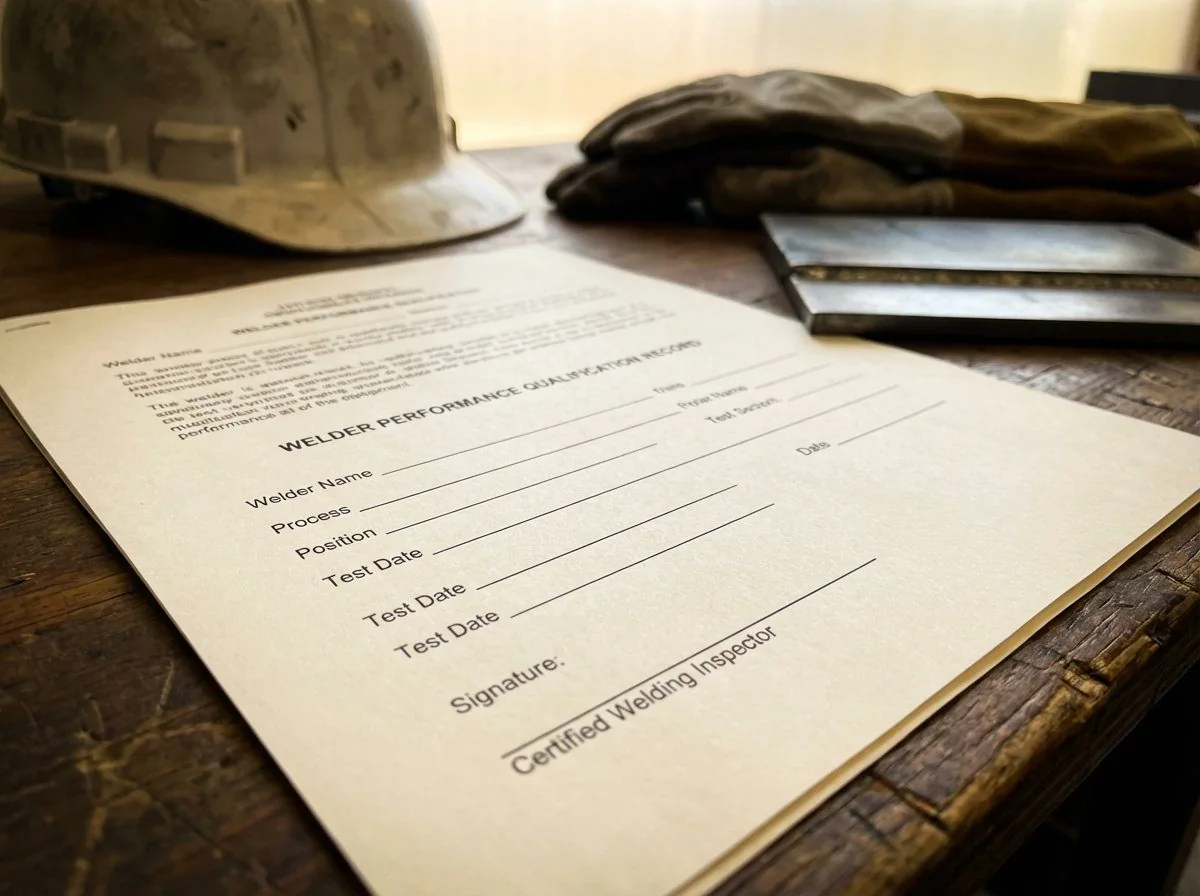
CWI signs and issues the official WPQ record on passing. Delivered by email and mail. See timeframes for current turnaround.
Industries That Require the 2G Qualification
Structural Steel Fabrication
Many shop fabrication operations involve horizontal groove welds on beam connections, column splices, and horizontal structural members. The 2G qualification satisfies the position requirement for fabrication shops where overhead and vertical work is not in scope.
Tank and Vessel Fabrication
Horizontal seam welds on storage tanks, pressure vessels, and process equipment are a primary application for 2G qualification. Shell-to-shell circumferential welds on horizontal vessels are a direct 2G application.
Equipment Manufacturers
Heavy equipment manufacturers, rail car fabricators, and industrial machinery builders routinely employ welders qualified in flat and horizontal positions. The 2G covers the majority of welding positions encountered in controlled shop environments.
Bridge Fabrication Shops
Girder fabrication, flange-to-web welds, and many shop-applied connections on bridge components involve horizontal groove welds. Bridge fabrication shops operating under D1.5 often require D1.1 2G qualification for shop welders.
Real-World 2G Production Applications
The 2G qualification is most useful when production work genuinely matches the test position. Here are the specific weld scenarios where a 2G WPQ is the correct credential — not a stepping stone toward something broader.
Horizontal Pressure Vessel Shell Seams
Circumferential butt welds joining cylindrical shell courses on horizontal vessels. The pipe-on-its-side geometry creates a continuous horizontal weld axis. For D1.1 structural vessels (non-pressure or atmospheric), the 2G is the standard qualification. Important: ASME pressure vessels require ASME Section IX, not D1.1 — see the ASME comparison below.
Storage Tank Shell-to-Shell Welds
Horizontal seams between stacked shell courses on cylindrical above-ground storage tanks. API 650 storage tanks for petroleum service have their own qualification rules, but many water tanks, atmospheric storage tanks, and process tanks built under AWS D1.1 use 2G-qualified welders.
Bridge Girder Flange-to-Web Welds
The full-length groove weld joining the flange plate to the web on built-up plate girders is typically welded in the horizontal position with the girder on its side. Bridge fabrication shops working under AWS D1.5 frequently require D1.1 2G qualification (the structural code references the 2G test for this application).
Horizontal Beam Splices and Column Connections
Shop-applied splice plate welds on structural members positioned with the splice axis horizontal. Many fabrication shops use beam rotators or fixtures that hold the work horizontal during welding — making the 2G the natural production qualification.
Rail Car and Heavy Vehicle Fabrication
Frame rail welds, body skin attachments, and structural connections on rail cars, trailers, and heavy haul equipment are commonly welded in the horizontal position using shop positioners. Rail car fabricators under AAR and FRA requirements typically work under AWS D1.1 with 2G or higher qualifications.
Crane Boom and Heavy Equipment Booms
Crane boom box-section welds, excavator boom plate welds, and similar heavy fabrication done with the assembly on its side typically uses horizontal welding. The 2G is a minimum qualification for these applications under AWS D1.1.
2G AWS D1.1 vs. ASME Section IX — When Each Applies
The 2G is the most likely D1.1 test to bump into the ASME boundary, because horizontal welding applies to vessels and tanks — and those split between D1.1 and ASME based on pressure rating. Getting this wrong creates the worst kind of compliance problem: a welder who passes their test, gets their WPQ, runs production welds, and then has the work rejected during third-party inspection because the wrong code was used.
| Application | Code That Applies | 2G D1.1 Sufficient? |
|---|---|---|
| Structural steel buildings, frames, beam splices | AWS D1.1 | Yes |
| Bridge girders & structural members | AWS D1.5 / D1.1 | Yes — D1.5 references D1.1 |
| Atmospheric storage tanks (no pressure) | AWS D1.1 / AWWA | Usually — verify with spec |
| API 650 petroleum storage tanks | API 650 (references D1.1) | Generally yes — verify with API spec |
| Crane booms & heavy equipment structures | AWS D1.1 | Yes |
| ASME Section VIII pressure vessels | ASME Section IX | No — separate qualification required |
| Boilers (ASME Section I) | ASME Section IX | No — separate qualification required |
| Process piping (ASME B31.3) | ASME Section IX | No — separate qualification required |
Glossary
Plate vertical, weld axis horizontal. The welder travels horizontally across the plate while gravity pulls the puddle downward. Qualifies flat and horizontal positions per D1.1.
Weld metal that flows downward under gravity on horizontal joints, causing overlap on the lower plate edge. The result of excessive heat input or slow travel speed.
A groove melted into the base metal along the upper weld toe that is not filled by weld metal. Maximum 1/32" depth per D1.1 Clause 4.9. Most common visual failure on the 2G.
A groove weld with full fusion through the entire joint thickness. The 2G test uses a CJP single V-groove with permanent steel backing bar.
Welder Performance Qualification record — the official CWI-signed document certifying the welder passed the 2G test. Lists positions covered, process, thickness range, and test results.
A narrow weld bead made by traveling in a straight line without weaving. The correct technique for horizontal groove welds — weaving promotes puddle sag on the 2G position.
Frequently Asked Questions
What positions does the 2G qualification cover?
Does the 2G cover vertical welding?
Should I take the 2G or go straight to the 3G?
What is the most common failure on the 2G test?
What plate thickness gives unlimited qualification?
Can I mail in my 2G test plate?
How long does the 2G certification stay valid?
Does changing electrodes require requalification?
What if the welder fails the 2G test?
Do I need a WPS to take the 2G test?
Why does the 2G have heat-related failure modes that the 1G does not?
Is the 2G qualification a good choice for tank and pressure vessel fabricators?
Did AWS D1.1:2025 change anything about the 2G test?
Does the 2G test produce a WPQ record or an AWS Certified Welder card?
The People Behind the Inspection
Every coupon submitted to WeldCertTest is inspected by a named, currently-certified AWS CWI. When a project inspector asks who signed your WPQ, you have an answer.


Ready to Qualify Your Horizontal Welders?
Mail-in service. CWI inspected. Official WPQ issued. Nationwide.
Also consider the 3G vertical — it covers everything the 2G does plus vertical for one plate.