What Is the 4G Plate Qualification?
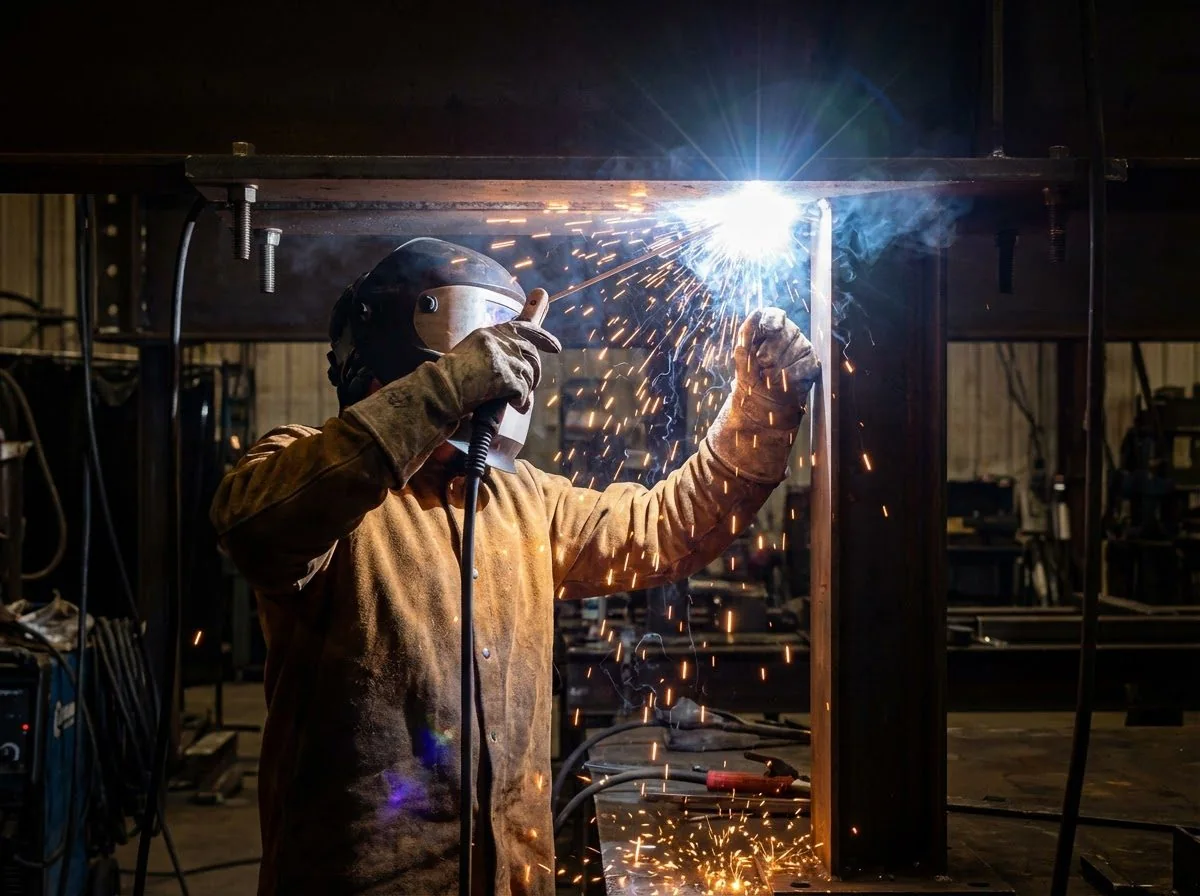
The AWS D1.1 4G plate qualification is a Complete Joint Penetration (CJP) groove weld test performed in the overhead position — the plate is positioned horizontally above the welder, and the weld is made from below. It is the most physically demanding single-position plate test in structural welding.
The "4" designates overhead. The "G" designates groove weld. Every ounce of molten metal wants to fall toward the floor — or toward the welder. Controlling the puddle overhead requires short arc length, lower-than-flat amperage, deliberate travel speed, and consistent body position. Passing the 4G is a legitimate demonstration of advanced welding skill.
The AWS D1.1 4G overhead plate qualification covers flat (1G), horizontal (2G), and overhead (4G) groove welds plus 1F, 2F, and 4F fillet welds per Table 6.10. It does not cover vertical (3G) — that requires a separate test, or the combined 3G/4G qualification covers all positions at once. Test on a 1-inch ASTM A36 plate for unlimited thickness qualification. Single V-groove CJP with 45° included angle, 1/4" root opening, 1/4"×1" A36 backing bar. SMAW with 3/32" E7018 is the most common process for overhead. The 4G is the most physically demanding single-position plate test — the standalone 4G is the right choice when adding overhead to an existing 3G qualification; for new welders starting fresh, the 3G/4G combined is usually more cost-effective. WeldCertTest performs all CWI inspection in Alpharetta, GA (Timothy Dodd, AWS CWI #00120381). The result is an official WPQ record — not an AWS Certified Welder card, which is a separate program.
Why the 4G Is the Hardest Plate Test
Every other plate position has gravity working with you to some degree — even the 3G vertical uphill allows the puddle to build against the leading edge of the bead. Overhead removes that entirely. The puddle has no support except the surface tension of the molten metal and the freezing rate of the filler. The welder's only tools are arc length and travel speed.
Beyond the physics, the body position is uncomfortable. Welding overhead means working with arms raised, neck craned back, and spatter falling directly at your face and neck. Fatigue sets in faster than any other position. The best overhead welders aren't necessarily the most technically gifted — they're the ones who've conditioned their bodies for the position and can hold a consistent arc through discomfort.
The 4G Position Is Hazardous If You Cut Corners on PPE
Of all the plate positions, overhead is where PPE shortcuts catch up with welders fastest. Molten slag and spatter falling at 9.8 m/s² toward your face, neck, and arms is not theoretical — it's continuous for the duration of the weld. Don't run a 4G test without these in good condition:
- Leather welding hood with full skirt — extends down the neck and shoulders. A standard pancake-style hood without a skirt will not protect against falling slag.
- Leather welding cap under the hood — protects the top of the head from anything that gets past the hood seal.
- Buttoned-up leather welding jacket with collar up — not just sleeves. Slag finds open collars instantly.
- Closed-toe leather boots with pants worn outside boots — never tucked. Tucked pants are a slag trap.
- Heavy gauntlet-style welding gloves — full forearm coverage, not driver-style gloves.
- Safety glasses under the hood — flying spatter can get behind the lens when you flip up.
This is also the position where welders most often need to take breaks during the weld. Don't fight fatigue to finish in one pull — set the electrode down, step away, reset your shoulders, and continue. A weld interrupted by a deliberate pause is fine; a weld interrupted by an arc strike outside the joint because your shoulder gave out is an automatic rejection.
What the 4G Qualification Covers
A standalone 4G qualification provides broad position coverage — but with one notable gap. Per AWS D1.1 Table 6.10, passing the 4G overhead groove weld test qualifies the welder for the following positions:
| Weld Type | 1G Flat | 2G Horiz. | 3G Vert. | 4G OH | 1F | 2F | 3F | 4F |
|---|---|---|---|---|---|---|---|---|
| 4G Groove Test | ✓ | ✓ | ✗ | ✓ | ✓ | ✓ | ✗ | ✓ |
The gap is the 3G vertical position and 3F vertical fillet. The 4G does not cover vertical. This surprises many welders — intuitively, passing the hardest position should cover everything. But per D1.1's qualification logic, vertical is a distinct skill set that requires its own test. If your production work includes both overhead and vertical groove welds, you need either the standalone 3G in addition to this test, or the 3G/4G combined qualification which covers all positions at once.
Thickness Qualification
Same rule as every other plate test — the thickness you test on determines what you can weld in production. Use the 1-inch plate. The cost difference is minimal, the downside of testing on 3/8-inch and discovering the project requires unlimited thickness is not.
| Test Plate | Min Production | Max Production | Recommended? |
|---|---|---|---|
| 3/8" (9.5mm) | 1/8" | 3/4" max | Light fab only |
| 1" (25mm) | 1/8" | Unlimited | Yes — always |
Test Plate Specifications
Welding Processes for the 4G Test
Process selection matters more on the 4G than any other position. The overhead environment punishes processes that produce a fluid, slow-freezing puddle. SMAW E7018 dominates because it freezes quickly and the welder has direct control over heat through arc length and travel speed.
SMAW — E7018 (Recommended)
- Best puddle control of any process overhead
- Use 3/32" electrodes — smaller diameter = lower amperage = tighter puddle
- E7018 freezes faster than E6010, better for fill and cap overhead
- Store in rod oven — wet electrodes cause porosity and cracking
- Work angle: 90° perpendicular to plate face (pointing straight up)
- Travel angle: 5°–15° in direction of travel
- Most universally accepted by all structural contractors
FCAW — Flux-Cored
- FCAW-G (gas-shielded) works overhead with correct parameters
- Higher deposition than SMAW — faster but harder to control
- Reduce wire speed and voltage below flat position settings
- FCAW-S (self-shielded) viable for outdoor overhead work
- Slag removal overhead is harder — chip aggressively between passes
- Requires more practice to master overhead than SMAW
GMAW — MIG (Short-Circuit)
- Technically permitted under D1.1 for overhead
- Short-circuit transfer only — spray arc overhead is not viable
- High spatter overhead — full leather PPE essential
- Per D1.1: RT cannot substitute for bend tests on GMAW-S
- Less common for overhead structural testing — SMAW preferred
- Check project specs — some restrict GMAW on structural plate
Process Comparison — 4G Overhead
- SMAW: Best control, slowest, universal acceptance ✓
- FCAW-G: Good if parameters dialed, higher deposition
- FCAW-S: Field/outdoor overhead, no gas needed
- GMAW: Rarely used overhead, check specs first
- Each process qualifies separately — SMAW cert doesn't cover FCAW
- Match your test process to your production process
4G Overhead Welding Technique
Every experienced overhead welder will tell you the same thing: it's 80% body position and 20% technique. If you're uncomfortable, shaking, or can't brace your arms, no amount of welding knowledge will save you. Get comfortable first, then focus on arc length and travel speed.
Body Position and Bracing
- Brace both elbows against your torso or the fixture — eliminate shake
- Position your head to the side of the joint, not directly below it
- Crouch or kneel so the plate is 8–12 inches above your helmet — not arm's length
- Full leather jacket, gloves, and rear neck protection — spatter burns are serious overhead
- Use a welding blanket over your lap and shoulders if possible
- Test your body position before striking the arc — can you travel the full joint without repositioning?
Root Pass Overhead
- Keep arc length extremely tight — half the electrode diameter maximum
- Move slightly faster than feels natural — puddle sag starts the moment you slow down
- Use 3/32" electrodes for root — better control than 1/8"
- A narrow, slightly convex root bead is correct — wider is not better overhead
- Don't stop mid-pass if you can avoid it — a cold restart creates a slag trap
- Chip and grind root pass before fill — overhead slag is harder to see
Fill Passes Overhead
- Run stringer beads — no weaving overhead
- Each pass should be narrow and slightly convex — flat or concave will sag
- Grind any high spots flush before the next pass — humps trap slag
- Chip and wire brush every pass more aggressively than you would flat
- Allow brief interpass cooling — hot plate + overhead = guaranteed sag
- Build the groove with 3–4 stringers rather than 1–2 wide passes
Cap Pass and Final Inspection
- Cap reinforcement must stay under 3/16" — high caps fail visual
- Keep travel speed consistent — speed changes create high/low profile
- Tie tightly into both toes — undercut overhead is the most common visual failure
- After welding, inspect base metal adjacent to the weld for arc strikes
- Let the plate cool before shipping — thermal stress during transport won't affect welds but handling hot plate is dangerous
Common 4G Test Failures — And How to Avoid Them
Puddle Sag and Overlap
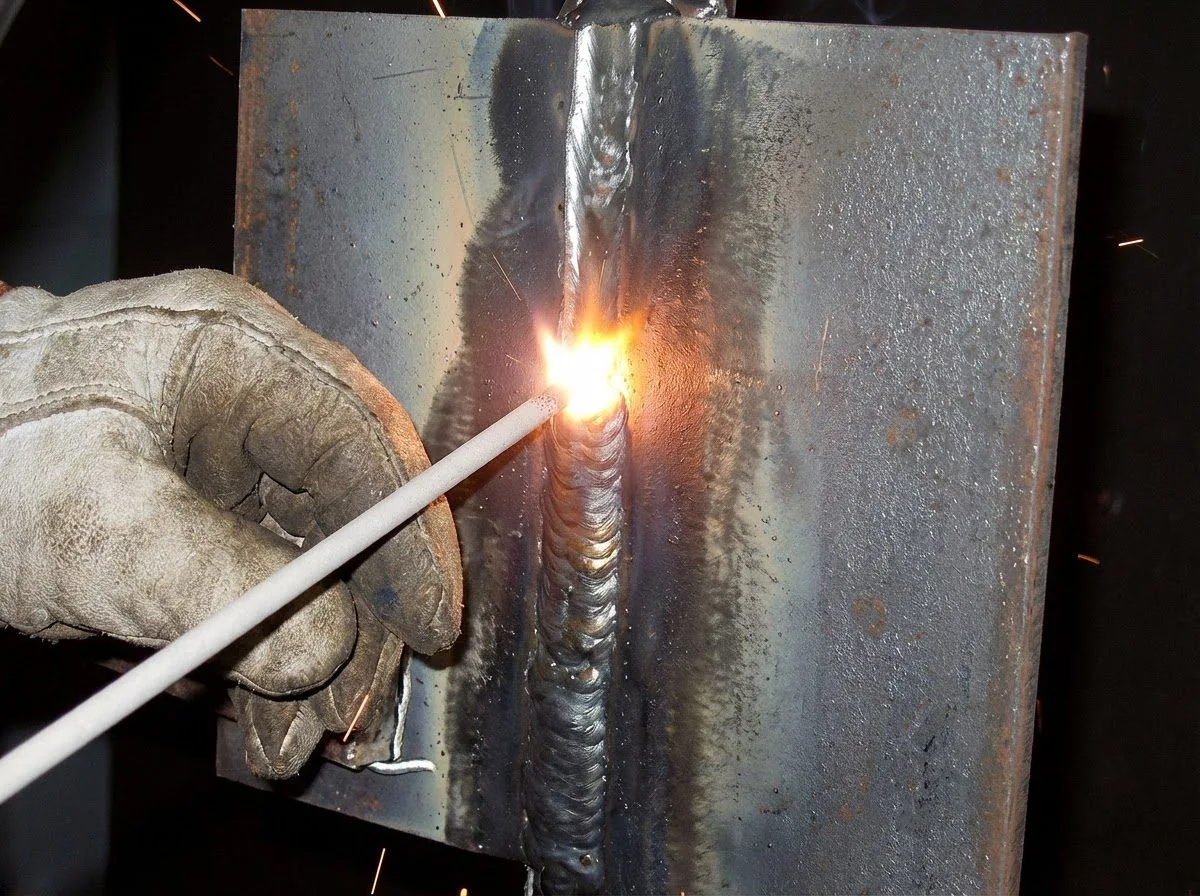
The overhead puddle runs downward and flows over the base metal — automatic visual rejection for overlap. Cause: arc length too long, amperage too high, travel speed too slow. Fix: shorten the arc, reduce amperage 10–15% from flat position settings, increase travel speed slightly, and run narrow stringer beads rather than weaving.
Incomplete Root Fusion
Most common bend test failure. Root pass didn't fully tie in to the backing bar, shows as a planar defect on root bend specimens. Cause: arc too far from the root, inconsistent root gap, or moving too fast through tight sections. Fix: aim the arc directly at the root opening, verify consistent 1/4" gap before starting, slightly higher amperage on root than fill passes.
Undercut at Cap Toes
Undercut exceeding 1/32" is an automatic visual rejection. Cause: moving too fast at the toes while trying to avoid sag, or excessive amperage on the cap. Fix: run the cap as stringer beads tied tightly into each toe. Pause briefly at each toe edge to ensure full tie-in. Reduce cap amperage below fill pass settings.
Arc Strikes Outside Weld Zone
Per D1.1 Clause 4.9, any arc strike on the base metal adjacent to the weld is an automatic visual rejection — no exceptions. Overhead welding increases this risk because electrode angles shift during repositioning. Fix: strike the arc on a scrap piece and transfer to the joint. Inspect base metal carefully before shipping the plate.
Slag Inclusions from Poor Interpass Cleaning
Overhead slag is harder to see and easier to miss. A thin layer of residual slag welded over creates linear inclusions that fail the bend specimens. Fix: chip every pass thoroughly, use a wire wheel grinder on each pass, and hold the plate at an angle under a light source to spot any residual slag before the next pass.
Body Fatigue Causing Inconsistent Travel
Overhead welding is tiring. As arms fatigue, arc length creeps up and travel speed slows — both cause puddle sag and inconsistent bead profile. Fix: condition your body before test day with practice sessions. On test day, take the time to position comfortably before each pass. A 30-second pause to adjust your stance is worth more than rushing through with bad bracing.
Visual Inspection Requirements
The completed 4G plate must pass visual inspection by an AWS CWI before any bend specimens are cut. Overhead plates get the same inspection criteria as every other position — the code makes no allowance for the difficulty of the position.
| Discontinuity | Limit | Notes |
|---|---|---|
| Cracks | None permitted | Any crack = immediate rejection |
| Incomplete fusion | None permitted | Anywhere in joint |
| Undercut | ≤ 1/32" (0.8mm) | Depth at toe of weld |
| Reinforcement height | ≤ 3/16" (4.8mm) | Above base metal surface |
| Arc strikes | None outside weld zone | Automatic rejection — no exceptions |
| Overlap | None permitted | Most common overhead visual failure |
| Porosity | Per D1.1 Clause 4.9.3 | Size and frequency limits apply |
Guided Bend Testing
Plates passing visual proceed to accredited laboratory bend testing. Four specimens are cut: two face bends and two root bends. The backing bar is removed before cutting. Each specimen is bent 180° in a guided bend jig. All four must pass — one failure fails the entire test.
4G Standalone vs. 3G/4G Combined — Which Do You Need?
This is the most important decision before you order a test. The answer depends on what the welder already holds and what the project requires.
| Situation | Best Choice | Why |
|---|---|---|
| Welder already holds valid 3G, needs overhead added | 4G Standalone | Most efficient — adds overhead without retesting 3G |
| Starting fresh, want full all-position qualification | 3G/4G Combined | One session, one cost, covers everything |
| Project requires "all-position certified" | 3G/4G Combined | 4G alone doesn't cover 3G vertical |
| Project only involves overhead groove welds | 4G Standalone | No need to pay for 3G if not required |
| Ironworker field erection work | 3G/4G Combined | Field work involves both vertical and overhead joints |
4G vs. All Plate Qualifications
| Test | Groove Positions | Vertical? | Overhead? | Plates |
|---|---|---|---|---|
| 1G Flat | 1G only | No | No | 1 |
| 2G Horizontal | 1G, 2G | No | No | 1 |
| 3G Vertical | 1G, 2G, 3G | Yes | No | 1 |
| 4G Overhead | 1G, 2G, 4G | No | Yes | 1 |
| 3G/4G Combined | All — 1G, 2G, 3G, 4G | Yes | Yes | 2 |
Cost Considerations — Why Standalone 4G Is Rarely the Best Value
Here's the honest commercial picture on the 4G: as a standalone test, it is almost the same price as a 3G but covers fewer positions (no vertical). For most welders, that math doesn't work out. The 4G alone makes sense in exactly one scenario: a welder who already holds a current 3G qualification and needs to add overhead coverage without redoing vertical. For everyone else, the 3G/4G combined test is the smarter spend.
The cost decision matrix:
- Already hold a current 3G WPQ — standalone 4G is the right call. Adds overhead capability without retesting your vertical skills. This is the situation the standalone 4G test exists for.
- Starting fresh, want all-position — go directly to 3G/4G combined. Modest premium over standalone 4G, covers all four groove positions including vertical.
- Project requires "all-position certified" — 3G/4G combined. The 4G alone does not satisfy that requirement because it doesn't cover 3G vertical.
- Ironworker field erection work — 3G/4G combined. Field welds happen in every position; vertical is constant.
- QC test program adding overhead to existing welders — standalone 4G can make sense for a fleet of 3G-qualified shop welders being trained for field work.
Contact WeldCertTest at (404) 860-1288 or request a quote online. We'll confirm whether the standalone 4G or the 3G/4G combined is the right test for your specific situation. If your welders don't already hold 3G qualification, we'll usually recommend the combined test — it's a better deal.
What Overhead Production Welding Actually Looks Like
The 4G qualification exists because real production work involves overhead groove welds. Knowing what those production welds look like helps welders, shop QC managers, and contractors decide whether the 4G is genuinely needed or whether a different qualification fits the actual work better.
Column Splice Top Welds
When two structural column sections are joined in the field, the upper splice weld is often performed by the welder working from below — the welder is on a platform with the column joint above their head. Field ironworkers performing column splices need 4G qualification (typically as part of 3G/4G combined).
Beam-to-Column Moment Connections
The bottom flange of a beam welded to a column flange requires the welder to work from underneath the beam, welding overhead into the joint. Modern moment-frame construction common in seismic regions involves significant overhead welding at every beam-to-column connection.
Shipyard Hull and Deck Plate
Shipyards build hulls from sections of plate that are welded together with the welder working from inside, outside, and below the assembly. Bottom plate welds on a hull section often require overhead position welding. Naval shipyard welders frequently hold 4G qualification as a minimum.
Bridge Girder Field Connections
Built-up plate girders on bridge spans often need field welds where the welder works from a scaffold below the girder, welding upward into a joint. State DOT bridge projects under AWS D1.5 reference D1.1 for welder qualification — overhead position qualification is the norm for bridge field welders.
Crane Runway Beam Connections
Industrial buildings with overhead bridge cranes have runway beams welded between columns at the crane elevation. Welders performing these connections often work from below the beam, welding upward into the column-to-runway joint. 4G qualification is standard.
Heavy Equipment Frame Closure Welds
Crane booms, excavator frames, and other heavy fabricated structures are built up from plate. When the structure is positioned for closure welds (the last welds joining the top plate to the assembly), those are overhead welds from inside the box section. Heavy equipment manufacturers use 4G-qualified welders for these critical closure joints.
Certification Validity — The 6-Month Rule
Per AWS D1.1 Clause 6.4.1 (2020 edition) — renumbered to Clause 6.4.1 in the 2025 edition — the 4G qualification is valid indefinitely as long as the welder uses the qualified welding process at least once every six months. The employer maintains a continuity log. If more than six months passes without using the process, the qualification expires and retesting is required.
Mail-In Service — How It Works
-
Contact us for WPS and quote
Confirm the process (SMAW, FCAW, etc.) and we provide pricing plus a qualified WPS. If you have an existing D1.1 prequalified WPS, you may use it.
-
Weld the overhead plate at your shop
Your welder completes the 4G plate under the WPS at your facility. Plate horizontal overhead in a fixture, 45° groove, 1/4" root opening, backing bar in place.
-
Ship the completed plate
Follow our shipping instructions. Standard ground shipping is fine. Include welder name, contact info, and process with the shipment.
-
CWI visual inspection
Our AWS CWI performs full visual inspection per D1.1 Clause 4.9. We contact you on any visual rejection before proceeding to bend testing.
-
Accredited bend testing
Four specimens cut, prepared, and bent per D1.1 at our accredited testing lab. Full test data documented.
-
WPQ issued and delivered
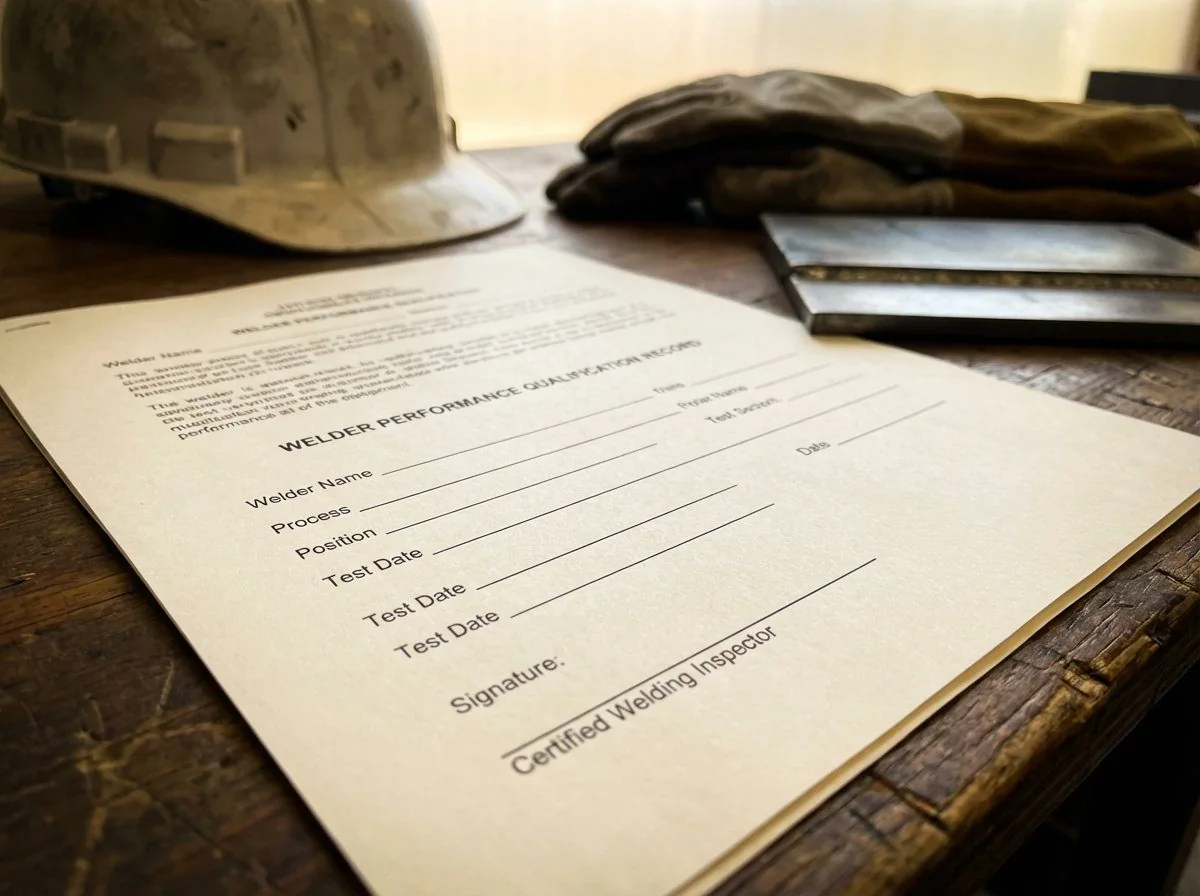
CWI signs and issues the official Welder Performance Qualification record on passing. Delivered by email and mail. See timeframes for turnaround.
Industries That Require the 4G Qualification
Structural Steel Erection
Field ironworker crews performing beam-to-column connections and structural splices encounter overhead groove welds regularly. Most structural erection contractors require the 4G or 3G/4G combined qualification.
Shipyards and Marine
Ship hull construction involves welds in every orientation including significant overhead work. Shipyard structural welders routinely hold 4G qualifications as a baseline credential.
Bridge Construction
Bridge girder flange and web connections, diaphragm attachments, and under-deck connections involve overhead groove welds requiring 4G qualification on D1.1 and D1.5 projects.
Industrial Maintenance
Maintenance welding on existing structures, process equipment, and plant infrastructure regularly involves overhead joints where equipment layout prevents repositioning the work.
Glossary
Overhead groove weld position per AWS D1.1. Plate is horizontal above the welder, weld made from below. The most physically demanding plate position.
A groove weld with full fusion through the entire joint thickness. The 4G test uses a CJP single V-groove with permanent steel backing bar.
Molten weld metal that flows downward under gravity during overhead welding, causing overlap on the base metal. The most common overhead welding defect.
Official AWS document signed by a CWI certifying the welder's qualification. Lists process, positions covered, thickness range, and test results.
Low-hydrogen SMAW electrode preferred for overhead structural welding. Freezes quickly, provides better puddle control overhead than higher-hydrogen electrodes.
D1.1 Clause 6.4.1 requirement: welder must use the qualified process at least once every 6 months or the qualification expires.
Frequently Asked Questions
What positions does the 4G qualification cover?
Why doesn't the 4G cover the 3G vertical position?
Should I take the 4G alone or the 3G/4G combined?
Is the 4G really the hardest plate test?
What electrode size is best for 4G SMAW overhead?
What is the most common reason for failing the 4G?
What plate thickness gives unlimited qualification?
Can I mail in my 4G test plate?
How long does the certification stay valid?
Does the 4G qualify fillet welds?
What if the welder fails the 4G test?
Do I need a WPS for the 4G test?
Is the standalone 4G ever the right choice for a new welder?
What overhead production work actually requires the 4G qualification?
Did AWS D1.1:2025 change anything about the 4G test?
Does the 4G test produce a WPQ record or an AWS Certified Welder card?
The People Behind the Inspection
Every coupon submitted to WeldCertTest is inspected by a named, currently-certified AWS CWI. When a project inspector asks who signed your WPQ, you have an answer.


Ready to Qualify Your Overhead Welders?
Mail-in service. CWI inspected. Official WPQ issued. Nationwide.