AWS D1.6 Stainless Steel Welder Qualification Testing
Mail-in AWS D1.6 stainless steel welder qualification for fabricators, food processing, pharmaceutical, and chemical processing industries. Your welder runs the coupon at your facility under an approved WPS. Ship it to Atlanta. We handle CWI inspection, accredited bend testing, and official WPQ documentation.
✓ We Test Your Coupons • ✗ We Are Not a Welding School • ✓ Official D1.6 WPQ Records Issued
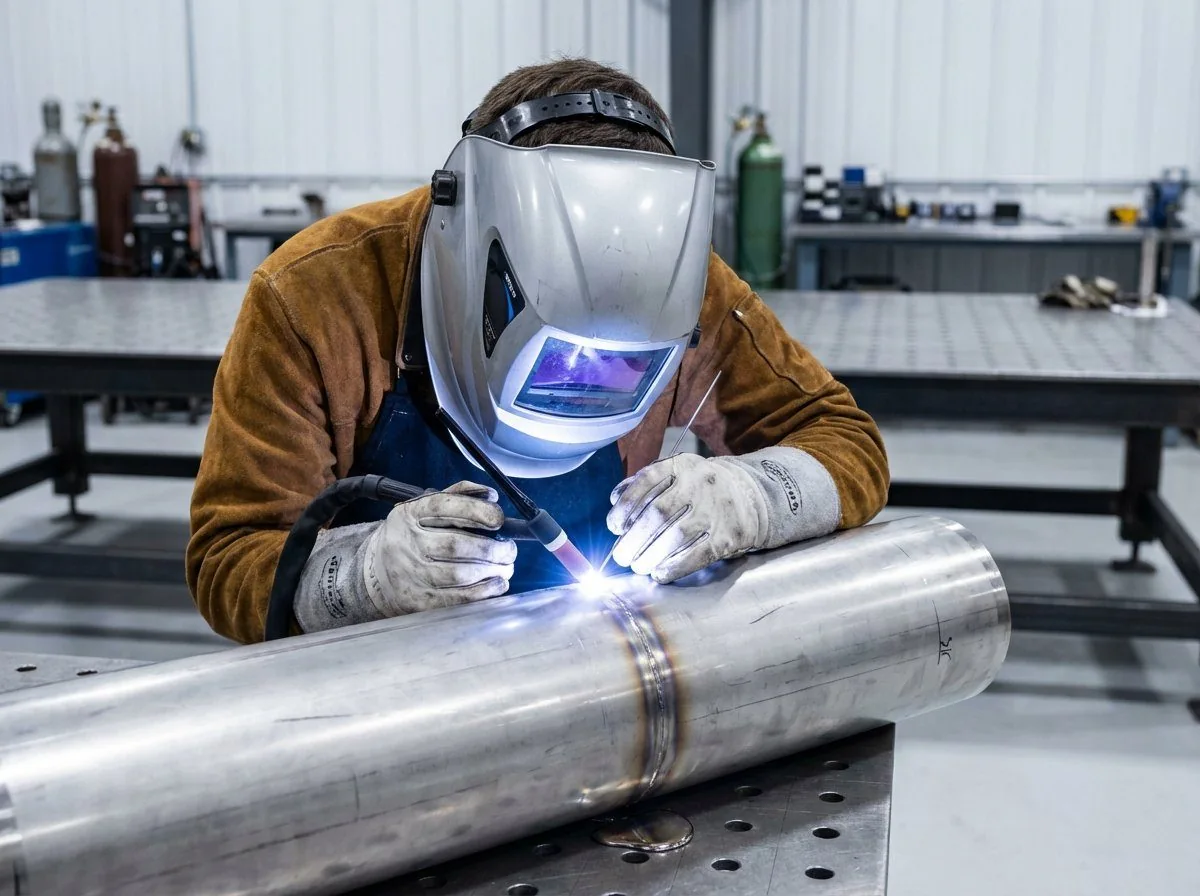
What Is AWS D1.6 and Who Needs This Qualification?
AWS D1.6, Structural Welding Code — Stainless Steel, is published by the American Welding Society and governs the design and fabrication of stainless steel structural members and connections. It is the companion code to AWS D1.1 (carbon steel) — same structure, different material family, different rules.
Welders who perform production welds on stainless steel structural applications must hold a current D1.6 qualification. Common industries and applications include:
- Food processing equipment fabricators — tanks, conveyors, structural frames in sanitary environments
- Pharmaceutical and biotech facility construction — 316L stainless structural supports and process equipment frames
- Chemical processing plants — corrosion-resistant structural members in aggressive chemical environments
- Marine and offshore fabrication — stainless structural components in salt water environments
- Architectural stainless steel — exposed structural members, handrails, curtain wall supports
- Brewery and beverage industry fabrication — sanitary stainless structural work
- Wastewater treatment facilities — stainless structural members in high-corrosion environments
Why Stainless Steel Welding Is Different — And Why Qualification Matters
Welders who are excellent on carbon steel routinely ruin stainless steel if they don't understand the material. The failure modes are different and the consequences are expensive:
Sensitization
Excessive heat input causes chromium carbide precipitation in the HAZ, destroying corrosion resistance. The weld looks fine visually but the base metal adjacent to it is now susceptible to intergranular attack. Low heat input and L-grade filler metals prevent this.
Carbon Contamination
Using carbon steel wire brushes, grinding wheels, or chipping hammers on stainless embeds iron particles in the surface. Those particles rust immediately — catastrophic in food or pharmaceutical environments. Dedicated stainless tools only.
Distortion
Austenitic stainless has a coefficient of thermal expansion about 50% higher than carbon steel and much lower thermal conductivity. It moves more during welding. Carbon steel welders using carbon steel technique on stainless produce badly warped assemblies.
Hot Cracking
Fully austenitic stainless weld metal is susceptible to solidification cracking. Proper filler metal selection — maintaining a target ferrite number — prevents this. Wrong filler, wrong technique, cracked weld metal.
AWS D1.6 vs. AWS D1.1 — Key Differences
| Factor | AWS D1.6 (Stainless) | AWS D1.1 (Carbon Steel) |
|---|---|---|
| Base Material | Austenitic & duplex stainless steel | Carbon & low-alloy structural steel |
| Primary Process | GTAW (TIG) dominant; SMAW, GMAW also | SMAW, GMAW, FCAW dominant |
| Interpass Temp Limit | 150°F max (austenitic) | Up to 400–600°F on most grades |
| Heat Input Control | Critical — sensitization risk | Important but more forgiving |
| Filler Metal | L-grade stainless ER308L, ER316L | Carbon steel ER70S, E7018 |
| Tool Contamination | Dedicated stainless tools required | Standard carbon steel tools |
| Cross-Qualification | Does not satisfy D1.1 | Does not satisfy D1.6 |
| M-Number / P-Number | M-Numbers (AWS system) | Not applicable (D1.1 uses other groupings) |
AWS D1.6:2017 — Current Edition Status
The 2017 edition was a significant restructuring of D1.6. Key authority points project teams should know:
- Restructured to parallel AWS D1.1. Clauses, numbering, and format were reorganized to better mirror D1.1 — so welders and inspectors familiar with D1.1 navigate D1.6 intuitively
- New direct reference to AWS B2.1. The 2017 edition added the option to qualify directly to AWS B2.1, Specification for Welding Procedure and Performance Qualification, without Engineer approval — while retaining D1.6 code qualification requirements if the Contractor prefers
- References AISC/SCI Design Guide 27 for structural stainless steel design
- Inspection clause restructuring. All visual Inspector and NDE personnel qualification requirements were consolidated in a single clause, with visual inspection acceptance criteria moved into a dedicated table similar to D1.1
- Flare-V and flare-bevel-groove prequalified joint details added to address common field need
Common Stainless Steel Grades — What You're Welding
| Grade | Type | Typical Filler | Primary Applications |
|---|---|---|---|
| 304 / 304L | Austenitic | ER308L / E308L-16 | General fabrication, food equipment, architectural |
| 316 / 316L | Austenitic | ER316L / E316L-16 | Marine, chemical, pharmaceutical — highest corrosion resistance |
| 321 | Stabilized Austenitic | ER321 or ER347 | High temperature service — exhaust systems, boiler components |
| 2205 Duplex | Duplex (Austenitic/Ferritic) | ER2209 | High strength + corrosion resistance — oil & gas, chemical |
| 430 | Ferritic | ER430 or ER309L | Less common — automotive trim, heat exchangers |
Position Coverage — AWS D1.6
Position coverage under D1.6 follows the same hierarchy as D1.1. More demanding positions cover easier ones.
| Test Position | Code | Positions Covered | Recommended For |
|---|---|---|---|
| Flat groove | 1G | Flat only | Rotator/positioner shop work |
| Horizontal groove | 2G | Flat + Horizontal | Limited shop applications |
| Vertical groove | 3G | Flat + Horiz + Vertical | Multi-position shop/field |
| Overhead groove | 4G | Flat + Horiz + Overhead | Overhead work coverage |
| 3G + 4G Combined | 3G/4G | All plate groove positions | Full plate coverage — recommended |
| Fixed pipe horizontal | 5G | All pipe positions | Pipe fabrication all-position |
| Fixed pipe 45° inclined | 6G | All positions — pipe & plate | Broadest single qualification |
Preparing Your D1.6 Test Coupon
- Use only stainless steel-dedicated tools — no shared wire brushes, grinders, or clamps that have touched carbon steel
- Use the correct L-grade filler metal matching your base metal grade as specified on your WPS
- Monitor and control interpass temperature — do not exceed 150°F between passes on austenitic grades
- Use low heat input — tight arc length, controlled travel speed, no excessive weaving on TIG
- Do not quench or water cool — allow the coupon to air cool naturally
- Mark the coupon with welder ID, date, position, process, and base metal grade before shipping
- Package per our shipping guide — stainless plate coupons are susceptible to surface damage in transit
AWS D1.6 vs. ASME, D1.3, D1.5, AWWA — Which Code Applies for Stainless Steel?
Stainless steel has the most cross-code overlap of any structural material. The same alloy in different applications falls under different codes — and substituting one qualification for another is a field rejection waiting to happen. Here is the full applicability map for stainless steel welding qualification:
| Application | Welding Code That Applies | Qualification |
|---|---|---|
| Stainless steel structural members, frames, supports (≥ 1/16 in thick) | AWS D1.6 | D1.6 WPQ |
| Pressurized stainless process piping (chemical, pharma, food) | ASME B31.3 + Section IX | ASME IX WPQ |
| Stainless steel pressure vessels | ASME Section VIII + Section IX | ASME IX WPQ |
| Power plant stainless piping (boiler feedwater, high-pressure steam) | ASME B31.1 + Section IX | ASME IX WPQ |
| Sanitary stainless tubing — dairy, food, beverage (clean-in-place) | ASME BPE / AWS D18.1 | BPE / D18.1 qualification |
| Pharmaceutical / biopharm stainless tubing | ASME BPE + ASME IX | BPE / ASME IX WPQ |
| Stainless sheet steel under 3/16 in (4.8 mm) | AWS D1.3 (limited stainless application) | D1.3 or D1.6 WPQ |
| Stainless steel bridge components | AWS D1.5 Bridge Welding Code | D1.5 WPQ |
| Stainless steel water transmission pipe (utility-owned) | AWWA C220 / C206 | AWWA WPQ |
| Carbon steel structural welding | AWS D1.1 (D1.6 does not apply) | D1.1 WPQ |
Real-World D1.6 Production Welding Scenarios
D1.6 applies to a wide range of structural stainless fabrication. These are the most common production contexts where the WPQ is verified by owners, engineers, and inspectors:
Food & Dairy Structural
Sanitary plant structural framing, tank supports, conveyor frames, mezzanine steel in food processing facilities. Typically 304/304L. Surface finish and absence of carbon contamination are inspected alongside the weld itself. USDA and FDA facilities verify D1.6 WPQs during plant qualification.
Pharma & Biotech Supports
316L structural supports for cleanroom equipment, biotech tank frames, fermenter platforms, support structures for process skids. Pharma and biotech project specs commonly require D1.6 documentation for structural — separate from the ASME BPE / IX qualification covering the process tubing itself.
Chemical Containment
Stainless structural members in chemical plants — secondary containment dikes, drip pans, structural supports adjacent to corrosive process equipment. Often 316L or duplex (2205) for chloride resistance. Owner QC verifies D1.6 WPQ for the structural welding even when adjacent pressure work is ASME B31.3.
Marine & Coastal Exposed
Stainless structural members on offshore platforms, coastal facilities, port infrastructure, marina handrails, dock support structures. Typically 316L (molybdenum-bearing) or duplex 2205 for chloride pitting resistance. Salt-water exposure means weld quality directly drives service life.
Architectural Facades & Rails
Exposed architectural stainless — curtain wall supports, decorative facade structural, exterior handrails, signage support structures, sculpture armatures. Cosmetic appearance is a real acceptance criterion alongside structural integrity. Heat tint and discoloration are visual defects.
Wastewater & Pulp/Paper
Stainless structural members in wastewater treatment plants, pulp mill bleach plants, and pulp/paper process areas. Aggressive corrosion environments demand 316L or duplex. Structural framing, walkways, equipment supports, and platform steel in these facilities are routinely D1.6-qualified work.
AWS D1.6 Stainless Steel Welder Qualification — FAQ
What is AWS D1.6 and who needs welder qualification under this standard?
How is AWS D1.6 different from AWS D1.1?
What stainless steel grades are covered by AWS D1.6 qualification?
Why does stainless steel welding require special qualification beyond D1.1?
What positions does AWS D1.6 welder qualification cover?
What filler metals are used for AWS D1.6 stainless steel qualification testing?
Does AWS D1.6 allow mail-in welder qualification testing?
What are essential variables under AWS D1.6 that require requalification?
How long is an AWS D1.6 welder qualification valid?
What documentation is issued after passing AWS D1.6 welder qualification?
What edition of AWS D1.6 is currently in effect?
Does an AWS D1.6 qualification satisfy ASME Section IX requirements for pressurized stainless process piping?
What kinds of stainless steel production welding actually require AWS D1.6 qualification?
Does an AWS D1.6 qualification produce a WPQ record or an AWS Certified Welder card?
Reviewed by the People Behind the Inspection
Every page on this site is reviewed by the people performing the actual qualification work — not anonymous content writers.

Timothy Dodd
AWS CWI #00120381 • ICC S2 #8184186
AWS Certified Welding Inspector. Performs all CWI visual inspection for WeldCertTest welder qualification testing. Reviews technical content for code accuracy. Owner of Xenogenesis, LLC.

Roger Baldwin
Site Owner & Operator
Owner and operator of WeldCertTest.com. 28 years in the broader nondestructive testing industry. Handles business operations; partners with Timothy Dodd for all CWI inspection and technical content review.
Ready to Qualify Your Stainless Steel Welders?
Mail your test coupon. We handle CWI inspection, accredited bend testing, and issue the official AWS D1.6 WPQ. Fabricators nationwide trust WeldCertTest.
Content reviewed by Timothy Dodd, AWS CWI #00120381 · Last reviewed May 16, 2026