How AWS D1.1 Welder Qualification Continuity Works
AWS D1.1 welder qualifications do not expire on a calendar date. Per Clause 6.4.1, a qualification remains valid indefinitely — but only when two conditions are continuously met: the welder must use the qualified welding process at least once every six months, and the employer must document each use in a continuity log. Both conditions. Not one or the other.
When the six-month window passes without documented use of the qualified process, the WPQ becomes invalid. The welder cannot legally weld on D1.1 structural steel projects until they pass a new qualification test. There is no grace period, no reduced-scope retest, and no paperwork shortcut that restores a lapsed qualification. A new plate, a new inspection, and a new WPQ are required.
AWS D1.1 welder qualification does not expire on a calendar date. It remains valid indefinitely as long as the welder uses the qualified welding process at least once every six months AND the employer documents each use in a continuity log. If the six-month window passes without documented use, the qualification lapses and a new qualification test is required. There is no abbreviated retest path — re-certification under D1.1 uses the same test as initial qualification. The substantive rule is unchanged in D1.1:2025 (Clause 6.4.1 — formerly Clause 6.4.1 in the 2020 edition). WeldCertTest performs all CWI inspection in Alpharetta, GA (Timothy Dodd, AWS CWI #00120381). Re-certification produces an updated WPQ record — not an AWS Certified Welder card, which is a separate program.
The 6-Month Rule — In Detail
The six-month continuity requirement is per process, per welder. A welder qualified in multiple processes must maintain continuity on each process independently. The most common trap: a welder qualified in both SMAW and FCAW spends a full year running exclusively SMAW production welds. Their SMAW qualification is current. Their FCAW qualification has lapsed — even though they welded every single day.
| Activity | Counts? | Notes |
|---|---|---|
| Production weld using qualified process | Yes | Any position, any project |
| Practice weld using qualified process | Yes | If documented by employer |
| Tack welds using qualified process | Yes | If documented — check with CWI |
| Welding with a different process | No | Continuity is per process |
| Welding for a different employer | No* | *Unless new employer accepts prior log |
| Being employed but not welding | No | Employment alone doesn't count |
| Training or classroom instruction | No | Must be actual welding with the process |
How Bad Is a Continuity Gap? — Severity by Lapse Length
Not every gap creates the same problem. The substantive code requirement (6 months) is a bright line — but how that line plays out in practice depends on how far past it the welder went and what work was performed in the meantime.
| Lapse Duration | Status | Practical Implications |
|---|---|---|
| Under 6 months Documented use within the window |
VALID | Qualification is current. Continue documenting use in the continuity log. Set a calendar reminder at month five to verify upcoming continuity. |
| 5.5–6 months Approaching the limit |
AT RISK | Still technically valid, but cutting it close. Schedule a qualifying weld using the process immediately and document it. If no production work is available, run a documented practice weld using the qualified process. |
| 6–12 months Recently lapsed |
LAPSED | Qualification void. New test required to restore. Skill is usually still strong — a warm-up session on scrap material followed by the test plate is the normal path. Most welders pass on first re-qualification attempt at this stage. |
| 1–3 years Long-term lapse |
LAPSED | Same code requirement as a 7-month lapse: full re-qualification. Recommend more practice time before testing — muscle memory degrades over years even when general welding skill remains. Plan extra warm-up sessions before running the test plate. |
| 3+ years Effectively initial qualification |
LAPSED | Approach as if starting from scratch. Verify the welder is still proficient before paying for a test plate. Consider scheduling a practice session and dry-run inspection before committing to a full qualification test. |
| CWI revocation Per D1.1 Clause 6.4.1(2) / 4.2.3.1(2) |
REVOKED | Independent of lapse length. A CWI can revoke a qualification at any point if there is specific reason to question the welder's ability. Re-qualification on a fresh test plate documents that the issue has been resolved. |
Common Re-Certification Scenarios
Continuity Lapse — Layoff or Injury
The most common scenario. Welder was laid off, injured, on extended leave, or simply wasn't assigned work requiring the qualified process. Six months passed. The WPQ is void. Solution: new plate, new test, new WPQ. The welder's skill is usually still there — they just need to demonstrate it again.
New Employer Requirement
Many companies require welders to re-qualify under their own supervision even when the welder holds a valid WPQ from a previous employer. Whether required by contract, company QC program, or project specification — a fresh qualification under the new employer's WPS satisfies the requirement cleanly.
Lost or Missing WPQ Records
No WPQ documentation means no proof of qualification regardless of how long or how well the welder has been welding. Audits, project closeouts, and compliance checks all require physical WPQ records. Re-qualification is faster and cleaner than attempting to reconstruct lost documentation.
CWI Revocation or Specific Cause
Per D1.1 Clause 6.4.1(2), a CWI can revoke a welder's qualification if there is specific reason to question their ability — weld quality issues, observed technique problems, or failed production weld inspection. Re-qualification on a fresh test plate resolves the question with documented evidence.
Process Change
Welder holds SMAW qualification but the new project requires FCAW. Different process = separate qualification required. The existing SMAW WPQ doesn't transfer to FCAW production work regardless of skill level. A new FCAW test plate is required.
Audit or Project Compliance Finding
QC audit revealed missing continuity log entries, expired qualifications, or documentation gaps. The fastest path to compliance is re-qualification — new plates, new WPQs, clean documentation from this point forward. We work with QC managers and owners to prioritize and sequence multiple welders efficiently.
Re-Certification Is the Same Test as Initial Qualification
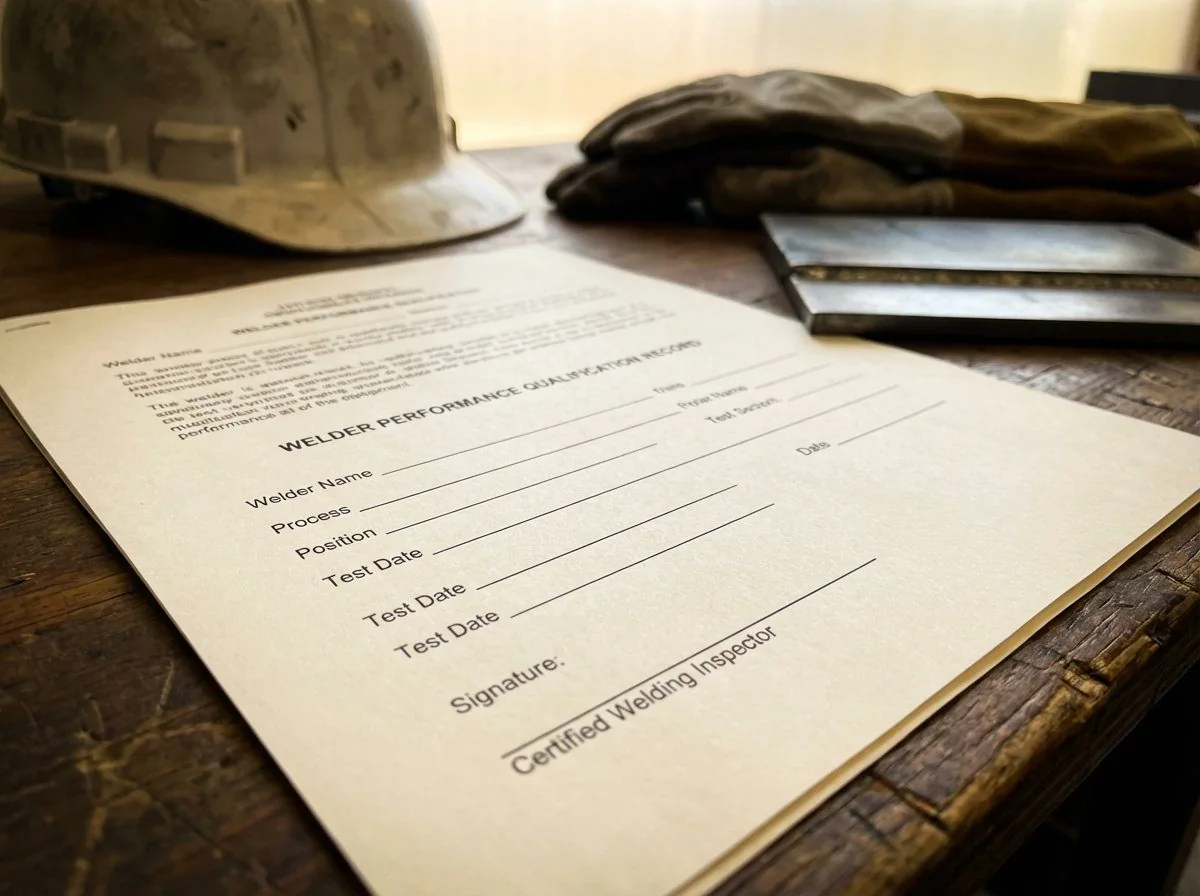
There is no abbreviated path under AWS D1.1 for re-certification. The test is identical to the original qualification — same joint configuration, same plate preparation, same CWI visual inspection criteria, same bend test requirements. The only difference is that the WPQ will carry a new issue date reflecting the re-qualification.
| Item | Initial Qualification | Re-Certification |
|---|---|---|
| Joint Configuration | Per D1.1 WPS | Same |
| Plate/Pipe Thickness | Per qualification range | Same |
| Visual Inspection | D1.1 Clause 4.9 | Same criteria |
| Bend Testing | 4 specimens, 180° | Same |
| CWI Signature | Required | Required |
| WPS Required | Yes | Yes |
| Abbreviated Retest Path | N/A | None available |
Choosing the Right Re-Certification Test
Re-certification is an opportunity to upgrade coverage. If a welder is retesting because their 1G lapsed, consider qualifying the 3G instead — same number of plates, broader coverage, and the welder won't need to retest again when vertical work comes up. Use the forced retest as a chance to come back with a stronger qualification.
| Test | Flat | Horiz. | Vertical | Overhead | Plates |
|---|---|---|---|---|---|
| 1G Flat | ✓ | ✗ | ✗ | ✗ | 1 |
| 2G Horizontal | ✓ | ✓ | ✗ | ✗ | 1 |
| 3G Vertical | ✓ | ✓ | ✓ | ✗ | 1 |
| 3G/4G All-Position | ✓ | ✓ | ✓ | ✓ | 2 |
| 5G Pipe | ✓ | ✗ | ✓ | ✓ | 1 coupon |
| 6G Pipe | ✓ | ✓ | ✓ | ✓ | 1 coupon |
How to Prevent Future Lapses — The Continuity Log
A continuity log is not complicated. It is a running record that the welder used the qualified process within the past six months. It does not need to be a formal document — a spreadsheet, a notebook, or a simple form maintained in the welder's file is sufficient. The requirement is documentation, not format.
| Date | Welder Name | Process | Project / Job No. | Supervisor Signature |
|---|---|---|---|---|
| 01/15/2025 | J. Smith | SMAW | Bridge Proj. 2025-04 | R. Johnson |
| 03/22/2025 | J. Smith | SMAW | Fabrication Shop Run | R. Johnson |
| 06/10/2025 | J. Smith | SMAW | Plant Expansion 7B | R. Johnson |
| 09/05/2025 | J. Smith | SMAW | Maintenance Contract | R. Johnson |
- Start the log on the day the WPQ is received — not after the first production weld
- Log every qualifying use of the process — don't wait until the five-month mark
- Set a calendar reminder at 5 months — one month buffer before expiration
- Keep the log in the welder's permanent qualification file alongside the WPQ
- When a welder changes employers, confirm the new employer will accept the existing log or start fresh
- Review all welders' logs quarterly — a missed entry discovered late is better than one discovered never
- Multiple processes require separate log entries for each process
The True Cost of a Lapsed Qualification
The fee for a re-qualification test is the smallest cost most contractors face when a qualification lapses. The real expenses come from the downstream consequences — and they accumulate quickly.
Direct: The Re-Qualification Test
Test plate material, CWI inspection, accredited lab bend testing, new WPQ documentation. This is the line-item cost. It is also the smallest of the downstream costs in most situations.
Lost Production Time
The welder cannot legally work on D1.1 projects during the lapse-to-recertification gap. For a daily-rate or hourly welder, every day out of compliance is lost revenue for the employer or lost wages for the welder.
Missed Bid Opportunities
Project bid documents commonly require documented current welder qualifications. A crew with lapsed qualifications cannot be listed on the bid. The lost contract value can dwarf the re-qualification cost many times over.
Audit Findings & Compliance Penalties
Third-party CWI inspections, owner audits, and project closeout reviews check welder qualifications. A lapsed qualification found during audit is a formal non-conformance — requiring documentation, corrective action plans, and possibly contract penalties.
Unwinding Non-Compliant Welds
If production welds were made during a lapse period and are later discovered during inspection, the welds may need to be reviewed, retested with NDT, or in extreme cases removed and re-welded by a qualified welder. The cost of unwinding a single shift of structural welding can be enormous.
Project Schedule Slippage
Re-qualification doesn't happen instantly — the welder needs practice time, the test plate must be welded, shipped, inspected, and bend-tested. A 1–2 week delay on a critical-path welder cascades to overall project delays. Liquidated damages on commercial projects can run thousands per day.
How a QC Manager Should Audit a Continuity Log
If a third-party CWI or owner's representative is coming on site for a project audit, the welder qualification file is one of the first things they will request. A clean audit is the difference between proceeding without disruption and a formal non-conformance finding. Use this checklist to self-audit before a third-party shows up.
Pre-Inspection Continuity Log Audit Checklist
Multiple Welder Re-Certification Programs
For fabrication shops, contractors, and industrial employers with multiple welders needing re-certification simultaneously, we can sequence and process multiple test plates efficiently. Tell us how many welders, which positions, and which processes — we'll provide a consolidated quote and work through them in order of priority.
Mail-In Re-Certification — How It Works
-
Contact us — tell us the situation
Process, last qualified position, reason for re-certification, number of welders. We'll confirm the test required, provide a WPS, and quote pricing. We've seen every scenario — call or use the quote form.
-
Welder preps and runs the plate
Same plate prep as initial qualification. Welder runs the test under the WPS at your facility. A warm-up session on scrap material before running the test plate is a good idea for welders returning after a long gap.
-
Ship the plate
Follow our shipping instructions. Standard ground shipping. Include welder name, process, position, and contact info with the shipment.
-
CWI visual inspection
Our AWS CWI performs full visual inspection per D1.1 Clause 4.9. We contact you on any visual rejection before proceeding to bend testing.
-
Accredited bend testing
Specimens cut, prepared, and bent per D1.1 at our accredited lab. Full documentation maintained.
-
New WPQ issued with current date
Fresh CWI-signed WPQ with new issue date delivered by email and mail. Start the continuity log immediately on receipt. See timeframes for current turnaround.
Glossary
The documented record showing a welder has used the qualified welding process at least once every six months. Required by D1.1 Clause 6.4.1 to maintain qualification validity.
Employer-maintained record documenting each qualifying use of the welding process. Must include date, welder name, process, project reference, and supervisor signature at minimum.
Welder Performance Qualification record — the official CWI-signed document certifying the welder passed the qualification test. The primary compliance document for D1.1 structural welding work.
A welder qualification that has become invalid due to a six-month gap without documented use of the qualified process. Requires a new qualification test to restore — no paperwork shortcut exists.
The AWS D1.1 provision governing welder qualification continuity. Specifies that qualification is valid indefinitely unless the welder has not used the qualified process for more than six months or there is specific reason to question their ability.
A change in welding conditions significant enough to require re-qualification under D1.1 Table 6.12. Includes changes in welding process, F-number group, base metal P-number group, and other factors. Continuity lapse is the most common cause of required re-qualification.
Frequently Asked Questions
When does an AWS D1.1 welder qualification expire?
What exactly is the 6-month continuity rule?
Is re-certification testing different from initial qualification?
Can a welder transfer a qualification to a new employer?
What if we lost the WPQ records?
Does welding with a different process count toward continuity?
Can we re-qualify multiple welders at once?
Should I re-qualify to the same position or upgrade?
How do we prevent qualification lapses going forward?
Can a CWI revoke a qualification without a continuity lapse?
Did AWS D1.1:2025 change the welder continuity requirement?
Does re-certification produce a WPQ or an AWS Certified Welder card?
How much does losing a welder qualification actually cost?
How should a QC manager audit a continuity log before a project inspection?
The People Behind the Inspection
Every re-certification plate submitted to WeldCertTest is inspected by a named, currently-certified AWS CWI. When a project inspector asks who signed your new WPQ, you have an answer.


Ready to Get Back in Compliance?
Tell us the process, position, and number of welders. We'll get you a quote and a WPS same day.
Mail-in service. CWI inspected. New WPQ issued with current date. Nationwide.